 EN
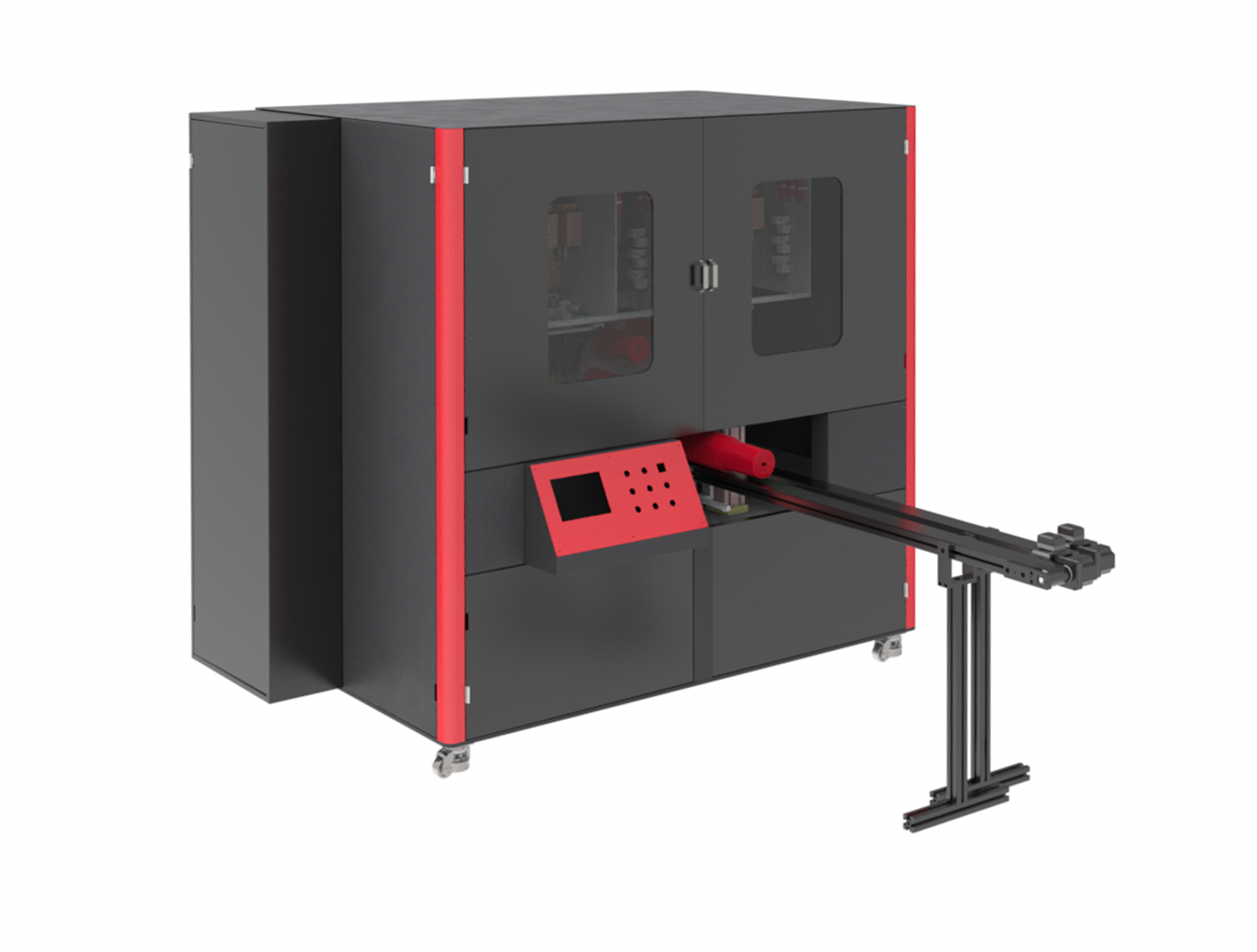
Every standard industrial printer ships with a quiet set of assumptions baked into its design. The printhead type, the curing wavelength, the conveyor height, the communication protocol: all of it was chosen around what the broadest slice of the market might need. On a line that runs one substrate at one speed with one ink chemistry, those assumptions may land close enough. On a line that was built to solve a specific production problem, they rarely do, and the gap gets paid for every shift in small, stubborn ways.
The hidden cost of a printer that almost fits
A curing lamp mounted twenty millimeters too far from the print zone. A feed table with friction points that scratch coated aluminum. An ink system tuned for a viscosity range that sits just outside what the coating line has already qualified. None of these issues stop production. That is precisely the problem. Operators learn to work around them, trimming line speed, adding a manual inspection step, accepting a defect rate that is tolerable only because the machine was never built for that exact job. The compromise becomes invisible on a capital request form, yet it compounds across every square meter that comes off the line.
Customization starts from the substrate outward. Part handling, printhead standoff, curing configuration, and motion control are specified around the material and the production rhythm the line actually runs, not around a generic duty cycle printed on a datasheet. The engineering effort shifts upstream, into the design phase, instead of leaking into daily operations as adjustment labor and scrap.
Why substrate and line integration decide real throughput
A customized printer for a unique production line is less about adding features and more about removing mismatches. A medical tubing operation in Ireland once spent seven months trying to adapt a standard flatbed to run silicone catheter sections before commissioning a machine built around a vacuum mandrel transport and a low-durometer contact surface. The customized line was producing within three days of installation. That is not a story about a better printhead. It is a story about a transport system that understood the material.
Integration tells the same story in electrical terms. Most factories do not run a printer in isolation. Upstream fillers, downstream cartoners, and line controllers all need to exchange handshakes and fault states without a kludge of signal converters. A standard machine often ships with a generic I/O block and a fixed protocol list. When the plant’s line controller speaks EtherCAT and the printer only offers discrete I/O, integration becomes a patchwork that creates obscure fault conditions months after commissioning. A customized build matches the electrical architecture to the plant’s automation stack from the start, so the printer behaves like a native station on the line rather than a foreign device that needs translation.
| Integration factor | Standard off-the-shelf printer | Customized printer |
|---|---|---|
| Protocol matching | Limited to built-in options, often discrete I/O only | Matched to plant standard (EtherCAT, Profinet, EtherNet/IP) |
| Integration engineering hours | 40–120 hours typical | 10–20 hours typical |
| Signal conversion hardware | External gateways often required | None, native protocol |
| Startup tuning after integration | 2–5 days | Under 1 day |
The numbers in that table come from mid-complexity packaging and converting lines, and they explain why the purchase price is a poor proxy for the real investment. Engineering hours and startup tuning are not line items on a quotation, but they show up in the project schedule and in the first month of production.
The total cost of ownership runs through uptime and consumables
Downtime is where the arithmetic gets uncomfortable. Senseye’s True Cost of Downtime research puts a single lost production hour at roughly $39,000 in fast-moving consumer goods and more than $2 million in automotive manufacturing. A printer that needs an extra two hours of integration troubleshooting at startup, or that forces a speed reduction to cure a heavy white underbase, does not just underperform on paper. It eats into that number repeatedly.
Consumable lock-in works the same way. Standard printers often ship with a narrow approved materials list, which creates single-source dependency for inks, cleaners, and spare parts. A customized specification can include an ink qualification program that certifies a second supplier during the build phase. In one contract packaging operation, that step cut annual ink spend by roughly 22 percent before the machine even shipped, an option the standard approved list did not allow.
The total cost of ownership calculation also has to include the labor that surrounds the printer. Pre-treatment, picking, inline inspection, and sorting often account for a larger share of system cost than the print engine itself, and a machine that integrates cleanly with those stations protects the ROI of the whole cell rather than just the printing step.
A real production line where two processes became one
The case for customization gets clearer when a line is carrying two incompatible processes. A PP corrugated box manufacturer in central China was printing large product images by screen and variable traceability codes by a separate CIJ unit. Two setups, two registration steps, and a defect rate near 15 percent. Daily demand was 100 boards; the old line could deliver 60 on a good day.
The customized solution was not a faster standalone printer. It was a wide-format UV inkjet line with a 1.8-meter print unit that covered a 1.2 by 4 meter board in a single pass, outputting the image and the variable code together with CCD registration keeping the two in alignment. The whole board ran through in under two minutes, matched to the existing conveyor rhythm. Scrap dropped, and the line could finally meet peak-season delivery windows.
That scenario is not unusual in packaging and industrial marking, where the printing step is really a data step. Once the printer is specified around the board, the conveyor, and the traceability requirement, the two-process compromise disappears. The investment case rests on removed handling, removed registration error, and recovered capacity, not on a print-quality claim in a brochure.
Where customization is not the right call
Customization is not universally superior, and treating it as a default is a good way to overspend. It costs more upfront, takes longer to deliver, and demands that the buyer knows the process well enough to specify requirements accurately. A shop buying its first digital printer and still experimenting with substrates may be better served by a standard machine that provides a known baseline, common spare parts, and a support team that has seen the exact configuration hundreds of times.
The decision turns on whether the gap between the machine and the application will be paid for over the asset’s life in engineering hours, scrap, and lost throughput. When the substrate is known, the volume is stable, and the cost of working around a mismatch is measurable, the premium for a tailored build is usually the cheaper path. When those conditions are absent, a standard machine is the honest choice.
For production environments that sit in between, a configure-to-order approach can bridge the extremes. NOVA Inkjet Technology builds customized industrial inkjet platforms around rotary, single-pass, and scanning architectures, with manufacturing and quality control processes aligned to the configuration rather than forcing every line into the same chassis. The value shows up in the engineering phase, where print engine, curing, and transport selections are matched to the line before steel is cut, and in the supply chain discipline that keeps a tailored build from turning into a one-off science project.