 EN
The answer is broader than the spec sheet suggests, and narrower than the sales pitch
A rotary inkjet printer is often presented as a machine that prints on “cylinders.” That framing is technically accurate and practically unhelpful, because the behavior of the process changes far more with the substrate than with the shape. A glass bottle, a PET jar, an aluminum can, and a polypropylene tube can all be cylindrical, and they do not behave the same way when ink hits the surface.
The honest way to think about substrate compatibility on a rotary platform is to separate the question into three layers. First, what materials can the print engine physically address. Second, what surface condition does the ink require to bond. Third, what does the finished part need to survive after it leaves the print zone. Most substrate failures on rotary inkjet come from skipping the second or third layer while assuming the first one covers everything.
Glass, metal, and the materials that look easy until they are not
Glass is the substrate most people picture when they think about rotary printing, and it is also one of the more demanding ones. The surface is smooth, non-porous, and chemically inert, which sounds ideal until the ink has to stay put through washing, handling, and temperature swings. UV-curable ink will wet out on glass, but wetting is not bonding. Without a primer or a surface activation step, adhesion tends to be marginal, and the failure mode is usually a clean peel rather than a gradual wear.
Metals sit in a similar category. Aluminum cans, stainless steel tumblers, and coated metal closures are all printable on rotary systems, but the ink is bonding to an oxide layer or a coating, not to bare metal. That distinction matters because the coating becomes the weak link. A powder-coated surface that looks uniform to the eye can have local variations in surface energy, and those variations show up as patchy adhesion after a few wash cycles.
The practical takeaway is that glass and metal are not “plug and print” substrates on a rotary platform. They are printable substrates that require a deliberate adhesion strategy, usually a primer layer or an atmospheric plasma treatment before the color goes down. A machine that prints beautifully on glass in a demo may still need a chemistry change before it survives a real fill line.
The plastic spectrum, where surface energy separates the easy jobs from the hard ones
Plastics are where substrate selection becomes genuinely nuanced, because “plastic” covers everything from a PVC shrink film to a polypropylene cap, and the surface energies span a wide range. The rule that governs adhesion is straightforward: the substrate surface energy needs to sit comfortably above the surface tension of the ink, and the gap between them determines how well the droplet wets out and anchors.
A rough hierarchy based on surface energy looks like this:
| Plastic family | Typical surface energy range (dyn/cm) | Rotary inkjet behavior without treatment |
|---|---|---|
| PVC, polystyrene | Mid to high 30s and above | Generally receptive, good wetting |
| ABS | Mid to high 30s | Usually printable with standard priming |
| PET | Low 40s | Printable, primer often improves durability |
| Polypropylene, polyethylene | Low 30s or below | Poor wetting, pretreatment usually required |
| Acrylic | Low 40s, but chemically specific | Primer or plasma strongly recommended |
The number itself is not a guarantee, because additives, mold release agents, and surface contamination can drag a nominally printable plastic into the difficult column. A polypropylene part from one molder may print acceptably while an identical part from another molder fails a tape test, simply because of what was in the tool or on the surface. This is why substrate qualification on a rotary line is rarely a one-time decision. It is a material-and-source-specific process.
The geometry problem that behaves like a substrate problem
Rotary printing introduces a variable that flatbed printing never has to confront: the print distance changes as the part rotates if the part is not a perfect cylinder. A tapered cup, a bottle with a pronounced shoulder, or a container with a handle all present a surface that moves toward or away from the printhead during the pass. That geometry changes the effective substrate presentation, even though the material itself has not changed.
A case from a promotional drinkware line illustrates the point. The job involved stainless steel tumblers with a slight taper and a powder-coated finish. The same ink and primer combination that performed well on straight-wall tumblers produced inconsistent density near the base of the tapered version, where the surface dropped away from the printhead. The adhesion was fine in the dense areas and marginal in the thin areas, because the ink film was thinner where the standoff increased. The fix was not a new ink. It was a fixture and motion profile that maintained a more constant print distance across the taper.
This is the part of substrate compatibility that gets lost in material lists. A rotary platform does not just print on a material. It prints on a geometry, and the geometry modulates how the material behaves in the print zone.
Pretreatment is not an admission of weakness, it is the process
The most common mistake in evaluating rotary inkjet substrates is treating pretreatment as a sign that the printer is not good enough. In reality, pretreatment is a normal part of the adhesion chain for non-porous materials, and the choice of pretreatment method is as much a substrate decision as the ink selection.
The main options behave differently depending on the material:
Primer coating: a liquid applied before printing that creates a receptive layer. Effective on glass, metals, and many plastics, but adds a process step and a drying or curing requirement.
Flame treatment: brief exposure to an oxidizing flame that raises surface energy on polyolefins. Fast and in-line, but not suitable for heat-sensitive parts.
Corona treatment: an electrical discharge that modifies the surface. Common on films and some rigid plastics, though the effect can fade over time.
Atmospheric plasma: a dry, in-line activation that cleans and raises surface energy without thermal load. Works on thermally sensitive materials and complex geometries, though equipment cost is higher than a simple primer station.
For glass and metal, primer or plasma is often the baseline. For polypropylene and polyethylene, some form of oxidative treatment is usually necessary to move the surface energy into a range the ink can wet. For PVC and polystyrene, the material may print acceptably with minimal preparation, but qualification testing is still the right move before committing a production run.
What the substrate has to survive after the print zone
A printed part that looks sharp on the fixture is not yet a qualified substrate combination. The post-print life of the part determines whether the adhesion was actually adequate. A cosmetic tube that goes into a carton and sits on a retail shelf has a different survival profile than a reusable water bottle that gets washed repeatedly, or an industrial container that sees solvent contact.
Three post-print stresses tend to expose weak substrate-ink bonds faster than anything else:
Repeated washing or immersion, which attacks the ink-substrate interface through moisture ingress.
Abrasion and handling, which tests the mechanical toughness of the cured film.
Chemical exposure, from fill contents, cleaning agents, or sterilization processes.
The qualification method that has held up best in practice is the crosshatch tape test, standardized as ASTM D3359. A grid is scored into the cured ink film, tape is applied and pulled, and the amount of ink removed is rated against a visual standard. It is not a perfect proxy for every end-use condition, but it catches adhesion failures early, before a production batch becomes scrap. For rotary work, the test should be run on the actual part geometry, not on a flat coupon of the same material, because the print distance and film thickness vary across the curved surface.
Where NOVA fits into the substrate question
The substrate question on a rotary platform is ultimately an engineering question about fixtures, motion control, and ink delivery as much as it is about ink chemistry. A material that prints well on a lab fixture can fail on a production line if the part handling introduces variation in print distance or surface contact. That is why the practical substrate range of a rotary system is shaped by how well the platform manages the part, not just by what the printhead can jet.
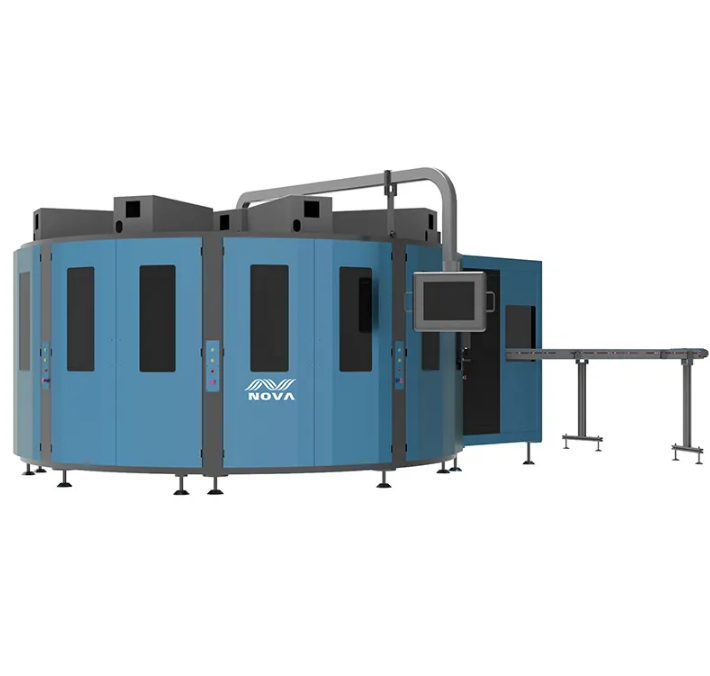
NOVA builds its rotary platforms around that reality, with fixture designs and motion profiles intended to hold print distance stable across tapers and contours, and with ink delivery configured around the pretreatment and curing sequence that a given substrate family requires. The manufacturing and quality-control discipline behind those builds matters because substrate compatibility is only repeatable when the mechanical side of the process is held to the same tolerance as the print side. For teams mapping out which containers and components belong on a rotary line, that operational consistency is often the difference between a material list that works in theory and one that holds up in production.
Table of Contents
- The answer is broader than the spec sheet suggests, and narrower than the sales pitch
- Glass, metal, and the materials that look easy until they are not
- The plastic spectrum, where surface energy separates the easy jobs from the hard ones
- The geometry problem that behaves like a substrate problem
- Pretreatment is not an admission of weakness, it is the process
- What the substrate has to survive after the print zone
- Where NOVA fits into the substrate question