
 EN
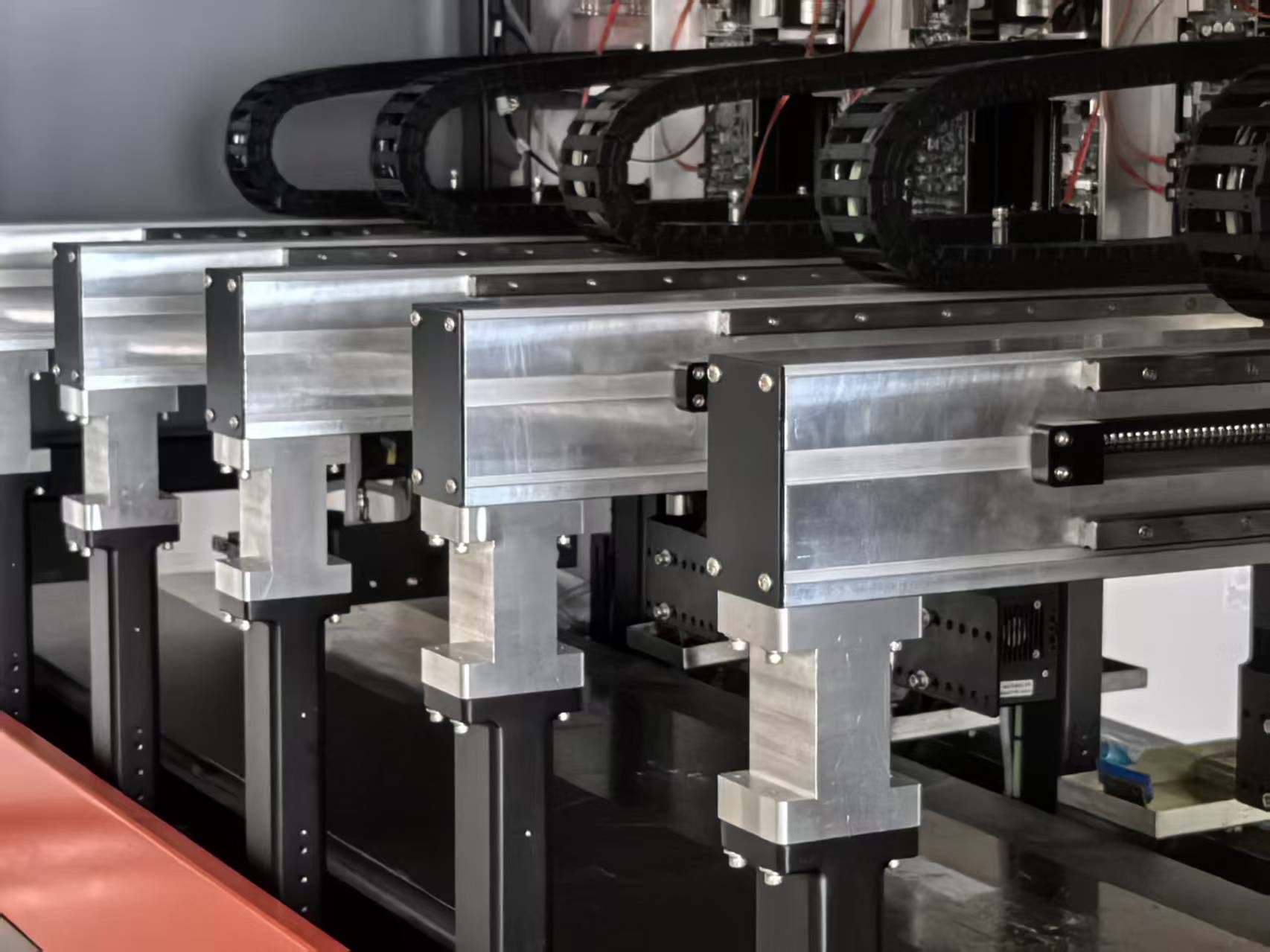
A scanning printer builds an image the way someone paints a wall with a roller: the head travels across the substrate, steps down, travels back, and repeats until the coverage is done. A single pass printer works more like a toll booth on a highway. The printheads stay still, the substrate moves underneath them once, and every color lands on the sheet in that single trip. The trick is not that the image appears by magic. It is that the entire color set has been laid out across the width of the media in a fixed sequence, and the timing of every drop is tied to the encoder pulse of the moving substrate rather than to a moving carriage.
The fixed array and the single trip underneath it
The core hardware is a page-wide or substrate-wide array of printheads, usually built from multiple head modules stitched together to cover the full print width. In a four-color CMYK configuration, the heads are arranged in order along the media feed direction, with each color plane sitting at a fixed station. The substrate passes cyan first, then magenta, then yellow, then black, or a sequence adjusted for the ink chemistry and the substrate. Every nozzle along that width has a defined position in the cross-web direction, and the image data is pre-sliced so that each nozzle knows exactly when to fire as the media advances.
What makes full color possible in one pass is that the color separation happens before the substrate moves, not during a back-and-forth cycle. The raster image processor breaks the artwork into per-color drop commands and sends them to the fixed bars in real time. Registration is maintained by the mechanical alignment of the head modules and by the encoder that tracks the substrate position at high resolution. There is no second chance to correct a misaligned color plane, so the stitching between adjacent head modules has to be precise down to the nozzle level.
Why a single nozzle failure matters more than in scanning mode
Single pass printing has a well-known sensitivity that scanning systems can hide. In a scanning printer, a weak or clogged nozzle affects one pass, and subsequent passes can partially mask the defect. In a single pass machine, a missing nozzle produces a continuous, visible straight line down the entire print, because there is no second pass to fill in the gap. HP’s engineering work on page-wide arrays describes nozzle health as critical for exactly this reason, and notes that a single pass array can carry more than 200,000 nozzles, all of which need to be monitored and compensated for in production.
The industry response is a combination of redundancy and software compensation. Nozzle redundancy places multiple nozzles in an overlap zone so that a failed nozzle can be substituted by a neighboring one. Compensation algorithms, such as Meteor’s NozzleFix, detect a deviated or dead nozzle, switch it off in the datapath, and use nearby good nozzles to apply compensating fluid in the same or a different color plane. That is what turns a potential streak into an invisible correction, and it is why the print quality of a single pass system is as much a software problem as a hardware one.
Color management and grayscale do the heavy lifting for image quality
Full color in one pass is not just about laying down four inks in the right order. The perceived smoothness of gradients, skin tones, and photographic detail depends on how many drop sizes each nozzle can produce and how the color management system maps the source file to the ink limit of the substrate. Industrial single pass heads commonly use multi-level grayscale firing, where each nozzle can eject several drop volumes rather than a single fixed drop. That variability, combined with halftoning and per-color calibration, is what keeps a one-pass print from looking like a flat, posterized approximation of the artwork.
The color management pipeline also has to account for the fact that the inks are being laid down wet-on-wet within milliseconds of each other. Dot gain, bleed between adjacent color planes, and the order of deposition all influence the final appearance. In a scanning system, the operator can intervene between passes. In a single pass line, the color profile and the firing order have to be dialed in during commissioning and held stable across the run. That is why printer builders invest heavily in waveform development and substrate-specific profiling before a machine goes into production.
| Production factor | Scanning head printer | Single pass printer |
|---|---|---|
| Image built through | Multiple back-and-forth passes | One substrate trip under fixed heads |
| Typical speed range | Up to ~300 m/h for scanning systems | 100–150 m/min in high-quality single pass modes |
| Effect of a failed nozzle | Partially masked by subsequent passes | Visible as a continuous line unless compensated |
| Width flexibility | Wider widths achievable economically | Practical width limited by head array cost and stitching |
| Best fit | Wide-format, low-to-mid volume, varied substrates | High-volume, fixed-width, repetitive production |
The speed gap is real, but the caveat is that maximum quoted speed and production speed are not the same number. In single pass machines, pushing speed higher reduces resolution in the web direction and can thin out ink density. A line running at the top of its speed window may not hold the color richness that the job actually requires. The usable production window is usually narrower than the headline figure, and that is a limitation worth planning around rather than ignoring.
A packaging line where one pass replaced two separate print steps
A food wholesaler in the north of England was producing branded pizza boxes, kraft bags, and short-run cartons through a mix of external suppliers and limited in-house capability. Lead times were long, and custom requests from local eateries were hard to turn around quickly. The operation installed a single pass printer and brought short-run packaging in-house, producing branded boxes and cartons on demand rather than waiting on a supply chain. The machine was running live customer orders by the second day after installation, which says something about how far single pass integration has come in packaging workflows that were previously tied to analog or outsourced steps.
That scenario is not about printing a photograph on a gallery wall. It is about printing a sellable, fully colored package in one pass at a speed that matches the converting line. The color requirement is real, but the bigger requirement is that the color arrives consistently, registration holds, and the line does not stop for a head recovery cycle every few hundred sheets. Single pass technology meets that bar when the substrate, the ink set, and the head array are specified together rather than bolted on after the fact.
Where single pass is the wrong tool, and what to specify instead
Single pass is not a universal upgrade. The head array cost scales with width, so very wide formats remain the domain of scanning systems. Substrate thickness and surface texture also matter: a single pass array has a fixed standoff from the media, and a warped board or a surface with high fiber tear can create head strikes that a scanning machine might survive with a higher head lift. Duplex printing is easier on web-fed single pass lines than on sheet-fed scanning machines, but sheet handling for thick rigid boards adds mechanical complexity that has to be engineered into the transport, not assumed.
The practical rule is that single pass pays off when the job is wide enough to justify a full-width array, repetitive enough to amortize the setup, and stable enough in substrate quality that the heads can stay close to the surface without constant intervention. For operations in that zone, the configuration work happens before the machine is built. NOVA Inkjet Technology approaches single pass platforms through print configuration testing, substrate-specific color management, and waveform development matched to the head and ink set, so the one-pass color output is defined by the application rather than left to a generic default profile.
Table of Contents
- The fixed array and the single trip underneath it
- Why a single nozzle failure matters more than in scanning mode
- Color management and grayscale do the heavy lifting for image quality
- A packaging line where one pass replaced two separate print steps
- Where single pass is the wrong tool, and what to specify instead