 EN
EN
The Rotation Problem That Cylinder Inkjet Solved
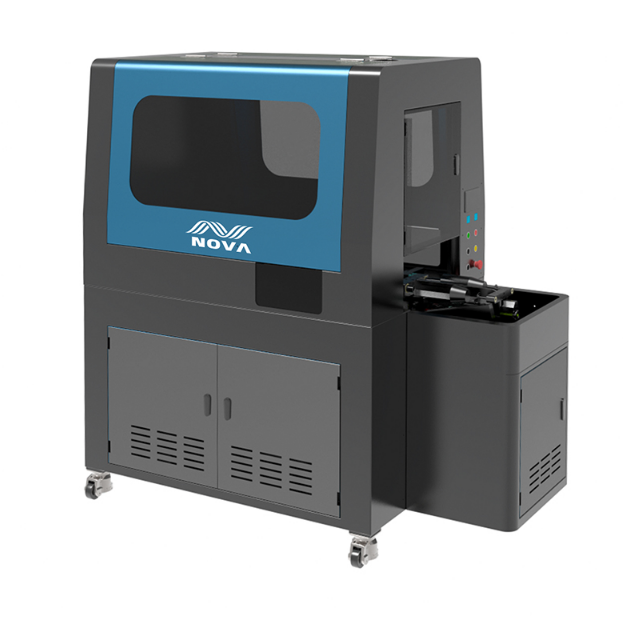
Bottles are round, and round objects hate staying still. Traditional screen printing on cylindrical containers relies on a curved screen that rocks across the bottle surface while a stationary squeegee forces ink through the mesh. The bottle must rotate in perfect synchronization with the screen carriage, or the image smears, loses registration, or shifts off center. That mechanical dance sets a hard speed limit. Every color station in a screen line needs its own rotation cam, its own squeegee pressure profile, and its own registration adjustment. Cylinder inkjet rewrites the rules. The bottle spins under a stationary printhead array that fires droplets in a helical pattern, wrapping the image around the circumference without any physical contact between the printing mechanism and the substrate. A beverage contract packaging plant in Poland replaced a six color screen line with a cylinder inkjet system and saw their bottleneck go from 38 bottles per minute to over 90, simply because the inkjet did not pause between colors and did not need squeegee pressure recalibration when humidity shifted during the afternoon shift.
Why Mechanical Registration Becomes a Speed Killer
Multi color screen printing on bottles demands mechanical registration at every station. Each screen must align with the previous color within a fraction of a millimeter, and that alignment drifts as tooling warms up, as squeegees wear, and as the bottle diameter varies batch to batch. Operators spend the first 20 minutes of a shift chasing registration, tweaking micro adjusters while the line runs scrap. Cylinder inkjet eliminates the entire concept of station to station registration because all colors print in a single pass under one printhead assembly. The digital file defines the color to color relationship, and the printer's encoder tracks the bottle rotation angle with sub degree precision. Shifting from four color process to single color spot on the fly takes a software switch, not a screen change and a 30 minute washout cycle. The table below captures the time sinks that separate the two technologies.
| Speed Limiting Factor | Traditional Bottle Screen Printing | Cylinder Inkjet Printing |
|---|---|---|
| Color station count impact | Linear slowdown per additional color | Negligible, single pass multi color |
| Job changeover duration | 25–45 minutes per color deck | Under 3 minutes, digital file load |
| Registration drift correction | Manual, ongoing throughout shift | Automatic, encoder locked |
| Scrap rate during startup | 8–15 bottles per color deck | 1–3 bottles |
| Maximum practical throughput | 40–60 bottles per minute (6 color) | 90–120 bottles per minute (6 color) |
The Physics of Ink Transfer on a Curved Surface
Screen printing ink transfer on a cylinder works by shearing. The squeegee blade presses the mesh against the bottle, and the ink shears through the open cells of the stencil as the bottle rotates away. The speed of that rotation directly affects the ink film thickness and edge definition. Rotate too fast and the ink film starves, producing a thin, washed out print. Rotate too slow and the ink floods, blurring fine details. Finding and holding that sweet spot across an entire production shift requires constant monitoring. Cylinder inkjet has no such shear rate dependency. Each droplet is ejected independently at a velocity between 6 and 10 meters per second, landing on the bottle surface with controlled spread that depends on ink formulation and substrate surface energy, not on how fast the bottle is turning. The bottle rotation speed in an inkjet system determines throughput, not print quality, so operators can dial it up to the mechanical limits of the handling system without degrading the image.
Single Pass Multicolor Changes the Economics
A six color screen line occupies serious floor space. Each station needs a flame treater or corona unit, a screen carriage, a squeegee assembly, a UV or hot air curing unit, and a transfer mechanism to move the bottle from one station to the next. That chain of equipment requires maintenance on every link. A cylinder inkjet system collapses all six colors into one print engine with one UV curing array positioned immediately after the print zone. The physical footprint shrinks by roughly 60 percent in a typical installation, and the number of consumable wear parts drops from dozens to a handful, primarily printheads and UV LED modules. For a mid volume cosmetic bottle decorator, that footprint reduction meant they could run two inkjet lines in the space formerly occupied by one screen line, effectively doubling their capacity without expanding the building.
When Short Runs Make Screens Too Expensive
Screen printing economics favor long runs. The cost of producing, coating, exposing, and reclaiming a set of screens gets amortized over tens of thousands of bottles. Below a certain quantity, the screen cost per bottle becomes punitive. A regional craft spirits producer ordering 2,000 bottles of a seasonal label faces an unpleasant choice, pay a steep screen setup charge or accept a high per unit cost. Cylinder inkjet has no screens, no plates, and no tooling. The same printer that runs a 50,000 bottle job on Monday can switch to a 500 bottle limited edition run on Tuesday with nothing more than a file change and a quick color profile verification. This flexibility lets brands test new label designs in market without committing to tooling investments, a capability that screen printing simply was not designed to deliver.
Limitations That Honest Production Teams Acknowledge
Cylinder inkjet is not faster for everything. On runs exceeding roughly 200,000 bottles of a single SKU, a well tuned high speed screen line with automatic registration can match or beat inkjet throughput because the amortized setup cost approaches zero and the mechanical speeds converge. Inkjet also requires a controlled environment, clean, dry compressed air and consistent ambient temperature, to keep printhead nozzles performing. Some bottle shapes, particularly those with sharp tapers or highly textured surfaces, challenge inkjet throw distance and demand creative part handling solutions that add complexity back into the system. And UV inkjet inks for cylindrical applications, while improving rapidly, still carry a higher cost per milliliter than bulk solvent based screen inks, a factor that matters when ink coverage per bottle is heavy.
Cylinder inkjet wins the speed argument in the vast middle ground of bottle printing, the short to medium runs, the frequent changeovers, and the multi SKU environments where mechanical registration eats more time than the actual printing. Nova Inkj et engineers its cylindrical print systems for that operational reality, focusing on fast job swapping and consistent encoder based registration to keep bottles moving instead of waiting.