 EN
EN
The Real Cost of Stopping a Production Line
Anyone who has managed a packaging or labeling line knows that stopping the line for a changeover is expensive. Not just in lost minutes, but in the ripple effect across downstream operations—filling, capping, packing, shipping. A 15-minute stoppage for artwork change on a traditional flexo or screen-printing setup can easily cascade into an hour of disrupted workflow.
Consider a typical scenario: a mid-size personal care contract packager runs three shifts, five days a week. Every artwork change requires cleaning rollers, swapping plates, running test prints, and verifying registration. That process eats 30 to 45 minutes per changeover. Over a year, with four to five changeovers per shift, the accumulated downtime reaches hundreds of hours. That is production capacity simply vanishing.
Single pass inkjet printers eliminate that entire ritual. But how exactly does the technology pull this off? The answer lies not in one single feature, but in a combination of architectural choices that fundamentally change how printing happens on a production line.
Fixed Printhead Arrays vs. Moving Carriages
The most important distinction between single pass and conventional printing methods is the printhead configuration. Traditional multi-pass printers—whether screen, flexo, or even scanning inkjet—rely on a moving carriage or rotating cylinder that applies ink in layers across multiple passes. Each pass requires mechanical repositioning, and each change of artwork means physical intervention with the printing medium itself.
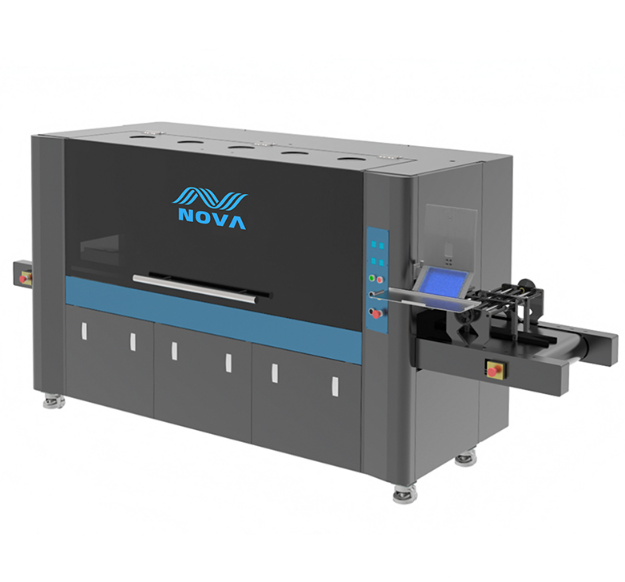
Single pass printers, by contrast, use a fixed array of printheads spanning the full width of the substrate. The substrate moves continuously beneath this stationary array, and the entire image is deposited in one seamless motion. There are no moving printheads to reposition, no plates to swap, no screens to clean.
This fixed architecture is what makes rapid artwork changes possible. Since the printheads never move, changing the image is purely a software operation—a new raster image processing (RIP) file is sent to the printer's controller, and the next substrate that passes under the heads carries the new design.
A packaging facility in the Midwest ran a side-by-side comparison between their existing flexo line and a single pass inkjet system for a line of seasonal beverage containers. The flexo line averaged 42 minutes per artwork change, including wash-up and plate mounting. The single pass system handled the same change in under 90 seconds, with zero mechanical intervention. Over the course of a four-week seasonal promotion with seven design iterations, the single pass setup saved roughly 18 hours of production time.
Digital Workflow Eliminates Physical Tooling
Flexo, gravure, and screen printing all require physical tooling—plates, cylinders, or screens—that must be manufactured, stored, and mounted for each unique artwork. This tooling is not just expensive; it is a logistical bottleneck. A new design might take days to plate, and if a brand decides to make a last-minute change, those plates become scrap.
Single pass digital inkjet has no physical tooling. The artwork exists as a digital file, and the printer renders it directly onto the substrate. This means that changing artwork is as simple as selecting a different file from the job queue. There is no inventory of plates to manage, no obsolescence risk, and no setup fees for short runs.
This capability is particularly valuable for variable data applications—printing unique QR codes, serial numbers, or batch-specific information on every single unit. A single pass printer can print different barcodes on consecutive products without slowing down, something that would be impossible with fixed tooling.
UV Curing and Instant Ink Fixation
A less obvious but equally critical factor is the curing mechanism. In conventional printing, inks often require time to dry or set, which means the substrate cannot be handled immediately after printing. This imposes constraints on line speed and creates opportunities for smudging or marking during downstream handling.
Single pass UV inkjet printers incorporate UV LED curing systems positioned immediately after the printheads. The ink is exposed to ultraviolet light fractions of a second after deposition, curing it instantly. This means the printed substrate can be handled, cut, folded, or filled immediately—no drying tunnels, no waiting, no risk of smearing.
The practical implication for artwork changes is that the printer can switch between designs without any curing-related adjustment. The UV system operates at the same intensity regardless of the image content, so a solid black panel and a fine-detail halftone cure at the same speed. There is no need to recalibrate drying parameters between jobs.
Real-Time RIP and Data Processing
The speed of artwork changes also depends on how quickly the printer can process new image data. Single pass printers run at production speeds—often 100 to 300 meters per minute or more. At those speeds, the printhead firing electronics must receive a continuous stream of pixel data synchronized with substrate movement.
Modern single pass systems use high-performance RIP engines and FPGA-based printhead drivers that can process and buffer entire images in advance. When a new artwork file is loaded, the RIP generates the firing patterns for all printheads simultaneously, accounting for nozzle compensation, color management, and drop placement corrections.
This preprocessing happens while the printer continues running the previous job. The switch occurs at the next substrate boundary, with no gap in production. Some systems can even perform what is called "job stitching"—printing different artworks on different parts of the same wide substrate, effectively running multiple jobs simultaneously.
What Single Pass Cannot Do (Yet)
No technology is without limitations, and single pass inkjet is no exception. The fixed printhead array means the printer is optimized for a specific print width. Changing to a significantly different substrate width may require physical reconfiguration of the head spacing, which is not a quick process.
Additionally, while artwork changes are instantaneous from a software perspective, the printer's color management may need recalibration if the new artwork uses dramatically different color profiles or if the substrate changes. This is not a mechanical changeover, but it does require some setup time—typically a few minutes rather than the hours required for plate changes.
The economics also favor certain use cases. Single pass printers have higher upfront costs due to the large number of printheads required to cover the full width. For operations with very infrequent artwork changes and extremely long runs, traditional methods may still be cost-competitive. The value proposition of quick changeover is most compelling for environments with frequent design updates, seasonal packaging, or variable data requirements.
The Production Floor Reality
A cosmetics contract manufacturer in New Jersey switched from screen printing to single pass inkjet for their tube decorating line. Their previous setup required three hours to change over between different SKUs—cleaning screens, mixing inks, running registration samples. With the single pass system, they now run batches as small as 500 units economically, whereas the screen line required a minimum of 5,000 units to justify the changeover cost.
That shift opened up new business opportunities. The manufacturer can now accept short-run promotional orders and test-market quantities that were previously uneconomical. Their average job size dropped from 12,000 units to 2,500 units, while overall throughput increased because changeover time essentially disappeared from the equation.
This is the real story behind quick artwork changes in single pass printing. It is not just about saving minutes—it is about fundamentally changing what kinds of orders a production line can accept and how responsive it can be to brand demands.
For operations considering the transition, the key question is not whether single pass can change artwork quickly—it clearly can. The question is whether the volume and frequency of changes justify the investment. For many packaging and labeling operations, the answer is increasingly yes, as brands demand faster turnaround and more frequent design refreshes.
NOVA's single pass inkjet solutions are engineered with this production reality in mind—built around industrial-grade printhead arrays, robust UV curing systems, and workflow software designed to minimize the gap between design file and finished product.