 EN
EN
The Drying Bottleneck That Everyone Talks About
Ink drying has been the limiting factor in printing since the first press was built. Traditional inks rely on evaporation or absorption, both of which take time. That time translates into handling delays, stacking restrictions, and production bottlenecks. In high-volume operations, drying time is not just an inconvenience—it is a capacity constraint.
UV printers eliminate drying time entirely. The ink does not dry; it cures. The distinction matters because curing is a chemical reaction triggered by light, not a physical process driven by heat or air movement. A UV printer achieves what looks like instant drying through photopolymerization—a reaction that turns liquid ink into solid polymer in milliseconds.
The practical implication is straightforward: pieces come off the printer ready for handling, packaging, or further processing. There is no waiting, no racking, no risk of smearing. This changes not just the printing process but the entire production workflow.
The Chemistry Behind Instant Curing
Understanding how a UV printer achieves instant drying starts with the ink chemistry. UV-curable inks contain four main components: monomers, oligomers, photoinitiators, and pigments.
Monomers and oligomers form the backbone of the ink film. They are liquid at room temperature but contain reactive groups that can form polymer chains. Photoinitiators are the trigger molecules. When exposed to UV light at the right wavelength, they break down into reactive species that start the polymerization reaction. Pigments provide color.
The sequence is precise: the print head deposits the ink on the substrate. UV lamps immediately expose the wet ink to intense ultraviolet light. The photoinitiators absorb the UV energy and generate free radicals. These free radicals attack the monomers and oligomers, linking them into long polymer chains. The liquid becomes solid. The entire reaction takes place in a fraction of a second.
This is fundamentally different from solvent-based inks, which dry through evaporation. Solvent inks leave behind the solid pigment and resin as the solvent evaporates. The process is slow, temperature-dependent, and can be disrupted by humidity. UV curing is fast, consistent, and largely unaffected by environmental conditions.
The Equipment That Makes It Happen
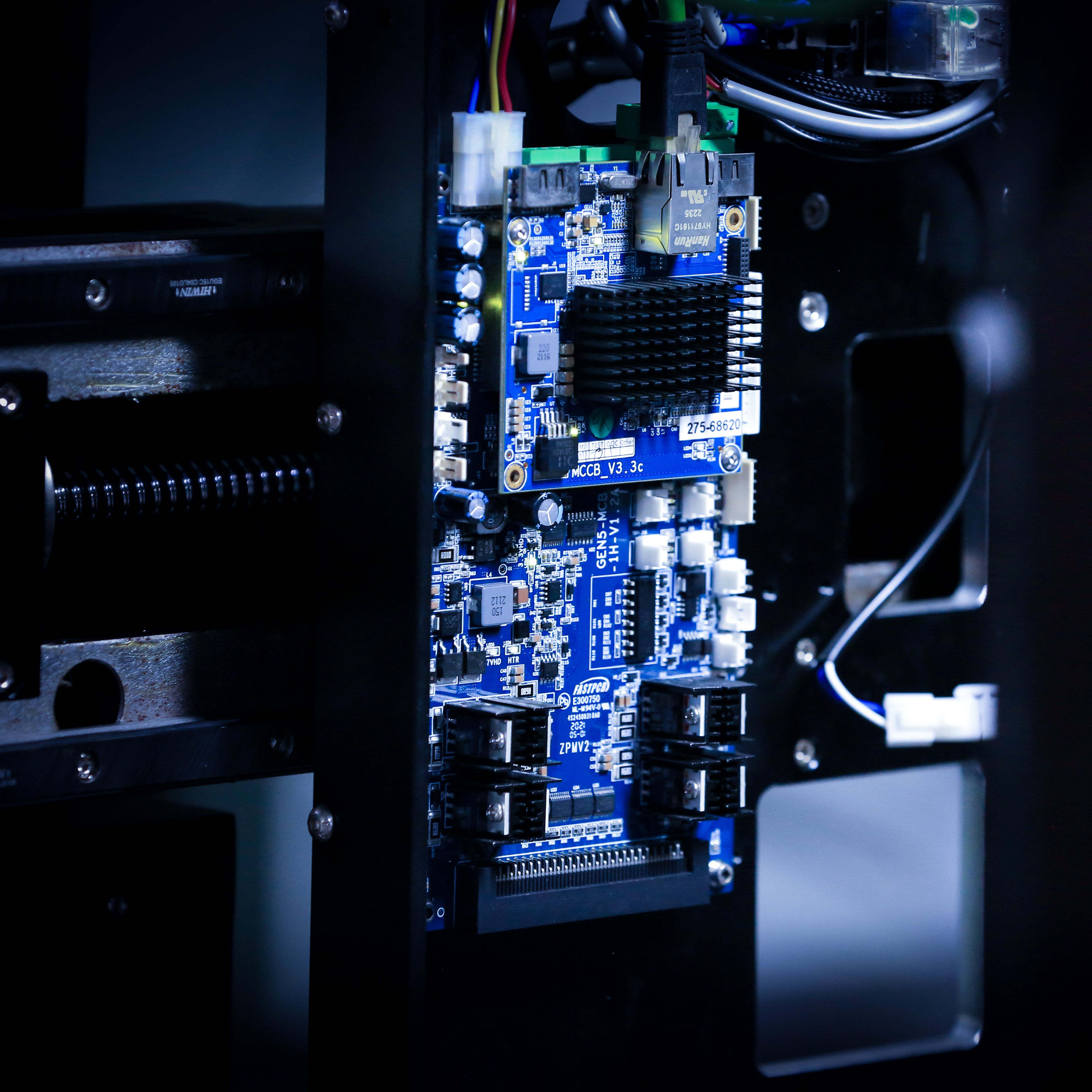
A UV printer achieves instant drying through a combination of print heads, UV lamps, and control systems working in close coordination.
The print heads deposit the ink with precision. Industrial print heads used in UV printers can fire droplets as small as 3 picoliters. The small droplet size allows for high-resolution images and also helps with curing—smaller droplets cure more completely because the UV light penetrates the thin ink layer more effectively.
The UV lamps are positioned immediately after the print heads. In many UV printers, the lamps are integrated into the print carriage, moving with the heads. This close coupling minimizes the time between ink deposition and curing, which is essential for preventing ink spread on non-absorbent surfaces.
The lamps themselves have evolved significantly. Traditional mercury vapor lamps produce broad-spectrum UV light but generate significant heat. UV-LED lamps produce narrow-band UV light at specific wavelengths. They are more energy-efficient, produce less heat, and last longer. The trend in industrial UV printing is toward LED curing because it allows for printing on heat-sensitive substrates like thin plastics.
The Two-Stage Curing Approach
Many UV printers use a two-stage curing process: pinning and full cure.
Pinning uses lower-intensity UV light to partially cure the ink immediately after deposition. The goal is not to fully harden the ink but to fix it in place—to prevent it from spreading, bleeding, or coalescing. Pinning is particularly important for multi-pass printing, where subsequent passes might disturb the wet ink.
Full cure uses higher-intensity UV light to complete the polymerization. The ink reaches its final hardness, adhesion, and durability. The full cure stage may use different lamps or higher power settings than the pinning stage.
The two-stage approach allows for better control over the final print quality. Pinning fixes the image, and full cure locks it in. Without pinning, the ink might spread between passes, reducing sharpness. Without full cure, the ink might remain soft and vulnerable to scratching.
The Surface Interaction That Matters
Instant drying is impressive, but it only works if the ink adheres to the surface. A UV printer can cure ink in milliseconds, but if the ink does not bond with the substrate, the cured film will flake off.
Adhesion depends on surface energy and chemical compatibility. High-energy surfaces like glass and metals generally provide good adhesion. Low-energy surfaces like polyethylene and polypropylene require pretreatment—plasma, corona, or flame treatment.
The UV printer's curing system contributes to adhesion by ensuring complete polymerization. Incompletely cured ink has lower cross-link density and weaker adhesion. The curing parameters—UV intensity, exposure time, wavelength—must be matched to the ink formulation and the substrate.
For dark substrates, curing presents an additional challenge. Dark colors absorb UV light, reducing the energy available for curing. The printer may need to use higher lamp power or slower print speeds to achieve complete cure on dark surfaces. White underbase printing is often used on dark substrates to provide a reflective layer that improves both color appearance and curing efficiency.
What Instant Drying Means for Production Workflow
The elimination of drying time has cascading effects on production workflow. Pieces can be handled immediately after printing. There is no need for drying racks, curing ovens, or waiting areas. The floor space previously dedicated to drying can be repurposed for other operations.
The reduction in work-in-progress inventory is significant. Without drying time, there is no queue of pieces waiting to cure. This reduces the capital tied up in partially completed goods and simplifies production planning.
Quality improves because there is no opportunity for dust or contaminants to settle on wet ink. In traditional drying, wet ink is vulnerable to environmental contamination during the drying period. UV curing eliminates this vulnerability.
| Workflow Aspect | Traditional Drying | UV Instant Curing |
|---|---|---|
| Handling delay | Minutes to hours | Immediate |
| Drying space required | Significant floor area | None |
| Work-in-progress inventory | Accumulates during drying | Minimal |
| Contamination risk | High during drying | None after curing |
| Stacking capability | Limited until dry | Immediate |
| Rework if smeared | Possible during drying | Not applicable |
The Practical Considerations That Operators Face
Instant drying sounds like a magic solution, but operators need to manage several practical considerations. The UV lamps generate heat, which can affect temperature-sensitive substrates. The printer's cooling system must remove this heat to maintain stable operating conditions.
Lamp intensity degrades over time. UV-LED lamps have long lifespans, but they do eventually lose output. Operators need to monitor lamp performance and replace lamps when output falls below specifications. Degraded lamps lead to incomplete curing, which shows up as soft prints or poor adhesion.
Ink formulation matters. Different UV inks have different curing requirements. Some cure faster than others, and some require specific wavelengths. The operator must ensure that the ink and the curing system are matched.
Print head maintenance remains important. UV inks can cure inside the nozzles if exposed to light, leading to clogging. The printer's maintenance routines—capping, purging, wiping—are designed to prevent this. Operators who skip maintenance will eventually face print quality issues.
A Case from a High-Volume Operation
A contract printer in the Midwest was running a line of custom-printed plastic cups for a national restaurant chain. The cups needed full-color graphics printed on the exterior, and the production volume was substantial. The printer was using solvent-based inks with a drying oven. The drying oven occupied a significant portion of the production floor, and the cups needed to cool before they could be stacked.
Switching to a UV printer eliminated the drying oven entirely. The cups came off the printer cured and ready for stacking. The floor space previously occupied by the oven was repurposed for additional printing capacity. The elimination of the cooling wait time increased the effective throughput of the line without increasing the printer's speed.
The operator reported that the biggest adjustment was learning to trust the curing process. After years of waiting for ink to dry, it felt unnatural to handle pieces immediately after printing. But once the process was validated and the quality checks confirmed consistent curing, the workflow became second nature.
The Energy and Environmental Angle
UV curing has energy implications that are often overlooked. Traditional drying ovens consume significant energy to maintain elevated temperatures. UV lamps also consume energy, but the consumption is concentrated in the curing moment rather than continuous heating.
The energy efficiency comparison depends on the specific equipment and production volume. UV-LED curing is generally more energy-efficient than mercury vapor lamps, and both are typically more efficient than thermal drying ovens for the same production output.
Environmental considerations include the absence of solvent emissions. Solvent-based inks release volatile organic compounds during drying. UV inks contain no solvents, so there are no VOCs to capture or abate. This simplifies compliance with environmental regulations and improves workplace air quality.
The Bottom Line on Instant Drying
Achieving instant drying with a UV printer is not a single feature—it is the result of a carefully engineered system that integrates ink chemistry, print head technology, UV curing, and substrate handling. The printer must deliver the right ink at the right place, cure it with the right light at the right time, and do all of this consistently over thousands or millions of impressions.
The benefit is not just faster printing. It is a reimagined production workflow that eliminates bottlenecks, reduces space requirements, and improves quality. For operations that have been constrained by drying time, the shift to UV printing is transformative.
NOVA Inkjet Technology has developed UV printer configurations that address the practical demands of instant curing in production environments. The company's approach emphasizes system reliability, curing consistency, and operator usability—the factors that determine whether instant drying works on the factory floor or just in the brochure.
Table of Contents
- The Drying Bottleneck That Everyone Talks About
- The Chemistry Behind Instant Curing
- The Equipment That Makes It Happen
- The Two-Stage Curing Approach
- The Surface Interaction That Matters
- What Instant Drying Means for Production Workflow
- The Practical Considerations That Operators Face
- A Case from a High-Volume Operation
- The Energy and Environmental Angle
- The Bottom Line on Instant Drying