
 EN
EN
Why the Glass Bottle Rotary Screen Printer Leads in Industrial Glass Printing
High-Volume Consistency: How Rotary Motion Enables >10,000 Bottles/Hour with Sub-0.1mm Registration Accuracy
When it comes to rotary screen printing, what really sets it apart is how the cylindrical screens rotate in sync with the moving bottles, creating this constant production line that just keeps going without stopping. Glass bottle printers using this rotary method can maintain registration accuracy below 0.1mm while cranking out over 10,000 bottles per hour, which is about four times faster than those old flatbed systems most factories still use. The technology behind it includes closed loop tension control that automatically adjusts the mesh pressure on those tricky curved surfaces so images don't get distorted when running at high speeds. Special vacuum mandrels hold each container steady during that brief 0.8 second printing moment, and the ceramic coated squeegees help deposit ink evenly across all surfaces. All these features together mean almost no variation in position between printed items and about 23% less material waste compared to older stop-start systems. For companies in the pharmaceutical and beverage industries where brand logos need to be spot on down to the millimeter, rotary screen printing has become essential equipment these days.
Proven Reliability: Case Study – Beverage Manufacturer Increases Uptime by 32% and Reduces Rework by 41% After Switching to Rotary Screen
One major beverage company swapped out their old flatbed printers for a new glass bottle rotary screen printing system, and what happened next was pretty impressive. Their machines stayed running at 98.2% uptime throughout the entire year, which is about 32 percentage points better than what they got from the older equipment. Problems that used to happen all the time, like when screens would get misaligned or run out of ink, simply disappeared. They installed this fancy UV curing module too, and it really worked wonders - smudged prints dropped by around three quarters. Plus, those automatic mesh cleaners kept things flowing smoothly even during those long 24 hour production stretches. All these improvements meant they had to redo work 41% less often, saving them approximately $740,000 each year according to a recent Ponemon Institute report on manufacturing costs. Looking closer at why this works so well, several factors stand out. The modular design of the print heads and mandrels cuts down maintenance stops by nearly 60%. Sealed bearings keep tiny particles from getting in during cleaning processes. And there are these clever vibration sensors that can spot issues with belt tension way before any actual problems start happening with registration. This just goes to show why rotary systems remain the most cost effective option for printing on glass bottles in large quantities.
How Glass Bottle Rotary Screen Printers Solve Curved-Surface Printing Challenges
Precision Fixturing & Adaptive Tensioning: Vacuum Mandrels and Dynamic Mesh Control Eliminate Smudging on Cylindrical Glass
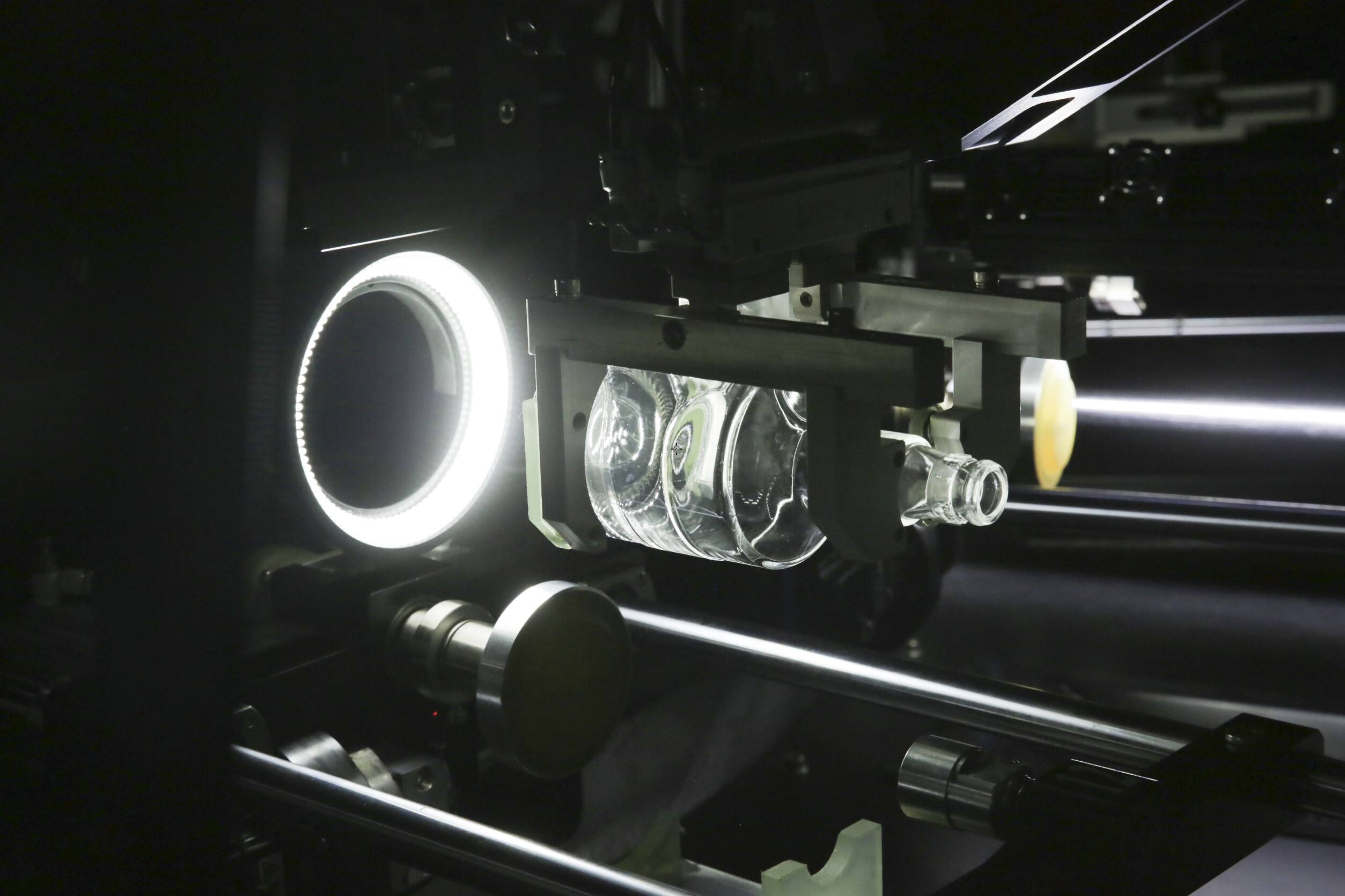
Getting good results when printing on round glass surfaces requires careful control so the ink doesn't slip around or get misaligned. That's where industrial rotary printing systems come in handy. These machines use vacuum mandrels that wrap all the way around bottles as they spin, which stops them from moving sideways at all. At the same time, there's something called dynamic mesh control working behind the scenes. This part keeps adjusting how tight the screen stays against the bottle surface as it changes shape, making sure the print stays clear and clean without smudges. When dealing with bottles that taper or have different widths along their length, special pressure sensitive mandrels kick in automatically to compensate for those shape changes. All these technologies combined can maintain registration accuracy down to less than a tenth of a millimeter, even when running through over ten thousand bottles per hour. Beverage companies report cutting down on rejected curved surface prints by about forty one percent thanks to these improvements.
UV-Curable Ink Integration: Optimized Squeegee Geometry and Cure Timing Ensure Sharp Edges on Non-Porous Glass Surfaces
The glass surface is not porous at all, which means we need special ink formulas and very precise timing during printing. These UV inks work great on glass surfaces creating strong bonds that resist chemicals too, but they won't perform well unless applied just right and cured properly. The squeegees used here are angled between about 60 to maybe 75 degrees, and their hardness needs to be carefully set so the ink comes off cleanly without spreading out too much. Timing matters a lot here too. The LED UV light has to hit the ink pretty quickly after it's applied, like within around half a second before the ink starts changing consistency and causes those ugly feathered edges. We also run quartz heaters to warm up the bottles first to about 40 degrees Celsius. This helps the ink flow better and settle down before it gets cured. All these elements working together let us produce really clear prints with good coverage, even on those tricky shaped bottles with ridges or patterns, where the printed lines stay sharp and defined down to less than a third of a millimeter thick.
End-to-End Glass Printing Workflow: Pre-Treatment, Printing, and Curing in One Rotary Pass
Today's glass bottle rotary screen printers combine surface prep, decoration work, and curing all in one smooth run through the machine, which eliminates those tedious manual steps and multiple transfer points between stages. The process kicks off with either plasma or flame treatment applied automatically to get the glass ready for better ink sticking. Right after this treatment phase, the bottles spin past precision screens that apply designs incredibly fast - we're talking over 10 thousand units per hour here! And they keep alignment spot on within just 0.1 millimeters even when dealing with tricky curved surfaces. What makes these machines really stand out is their built-in UV LED lights that cure the ink while the bottles are still spinning around, so there's no chance of smudging or messing up the design. According to industry data, switching to this single pass approach cuts down overall production time by roughly 40% compared to older methods that required several separate steps. Plus, manufacturers report seeing as much as a 62% drop in defects caused during transfers. All this means businesses can maintain top quality standards while pushing out massive quantities of printed glass products consistently.
Material and Shape Versatility: From Standard Cylinders to Complex Glass Bottle Geometries
Oval, Fluted, and Tapered Bottles: How Modular Mandrel Systems Maintain Registration Across Non-Uniform Glass Contours
Rotary screen printers for glass bottles take precision to new levels compared to regular cylinders, hitting around ±0.1mm accuracy even on tricky shapes like ovals, flutes, tapers, and slender profiles. What makes this possible? The secret lies in modular vacuum mandrel systems that adapt to whatever curve comes along. These systems hold the glass securely during fast spinning without warping it. When combined with mesh tensioning technology that adjusts pressure as needed, the printer avoids smudges on those hard to reach spots where details matter most, like embossments or textured sections. Drinks companies really benefit from this because they can keep their branding looking sharp across all different product lines. Factories run batches mixing various bottle styles at speeds over 10,000 per hour with no need for workers to constantly adjust things manually. Throw in single pass UV curing too, and manufacturers actually gain an edge when dealing with complicated shapes instead of seeing them as obstacles in production.
FAQs about Glass Bottle Rotary Screen Printers
What is the main advantage of using rotary screen printers for glass bottles?
The main advantage is the high-volume consistency they provide, allowing over 10,000 bottles per hour with sub-0.1mm registration accuracy, which greatly exceeds traditional flatbed systems.
How do rotary screen printers reduce defects in glass bottle printing?
They offer a fully integrated system that includes pre-treatment, precision printing, and UV curing in one pass, drastically reducing defects caused by manual handling and separate transfer processes.
Can rotary screen printers handle complex bottle shapes?
Yes, their modular mandrel systems and adaptive tension control make them capable of printing effectively on non-uniform glass contours such as ovals, fluted, and tapered shapes.
Table of Contents
- Why the Glass Bottle Rotary Screen Printer Leads in Industrial Glass Printing
- How Glass Bottle Rotary Screen Printers Solve Curved-Surface Printing Challenges
- End-to-End Glass Printing Workflow: Pre-Treatment, Printing, and Curing in One Rotary Pass
- Material and Shape Versatility: From Standard Cylinders to Complex Glass Bottle Geometries
- FAQs about Glass Bottle Rotary Screen Printers