
 EN
EN
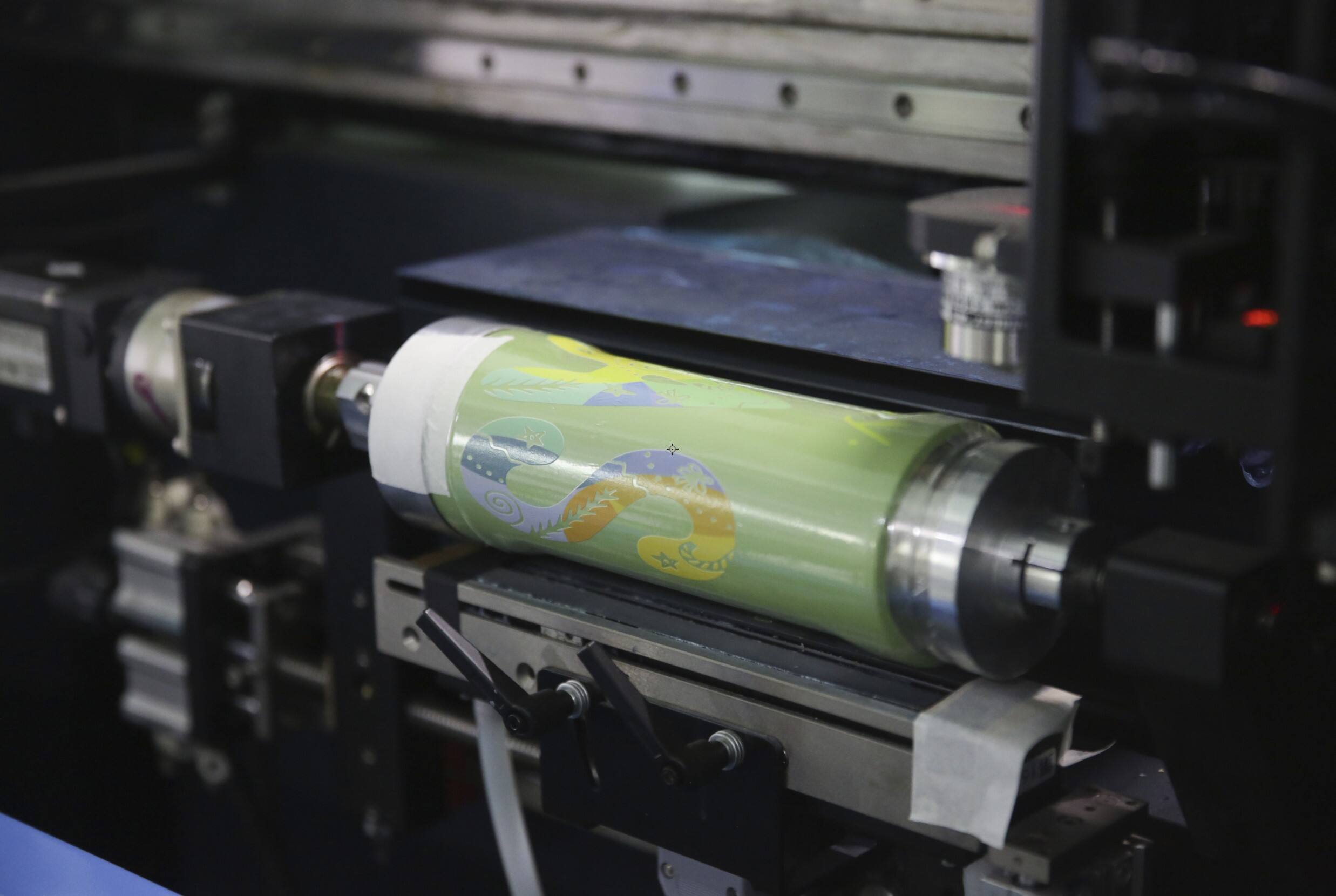
How Tumbler Inkjet Printers Enable Precision Direct-to-Object Printing
Rotary UV Inkjet Mechanics for Seamless Cylindrical Coverage
Tumbler inkjet printers work by combining rotating movement with special UV ink technology that allows printing around entire curved objects without any distortions. When the item spins inside the printer, tiny printhead nozzles spray microscopic amounts of UV reactive ink onto the surface at incredibly high resolution rates reaching 1440 x 1440 dpi. This ensures sharp details appear across the whole object with no missing spots or overlapping areas. The magic happens when ultraviolet light instantly cures the ink right after application, forming strong bonds with materials such as stainless steel or powder coated finishes. These bonds create coatings that resist peeling even under tough conditions. According to tests done in manufacturing facilities, these rotating systems actually cut down those annoying jagged edges (called aliasing) by nearly 80 percent when compared against traditional flatbed printing methods.
Helix One and Similar Benchmarks: Alignment Accuracy for Consistent 360° Prints
The printers keep sub-millimeter alignment pretty much spot on during the whole printing process thanks to those fancy optical registration systems and laser guided calibration tech. What these machines do is constantly tweak where the printheads move while they rotate, making up for tiny size differences down to just 0.3 mm in diameter. This means no one can see those annoying seams where the artwork starts and ends. We've seen some really good results from testing too. The best equipment out there hits around 98.7% first pass success rate when matching Pantone colors, even when running through big batches over 500 pieces each time.
UV Inkjet Technology: Curing, Adhesion, and Material Compatibility
Instant UV Curing on Stainless Steel, Plastic, and Powder-Coated Tumblers
UV inkjet printers work through a process called photopolymerization where specific UV light triggers the curing of inks right when they hit the surface. This means printed materials can be handled almost immediately after printing, there are no harmful VOC emissions to worry about, and most non porous materials don't need any special preparation before printing. When it comes to adhesion tests on stainless steel surfaces, these printers typically achieve between 15 to 18 MPa according to ASTM D3359 standards. Plastic surfaces maintain around 98 percent of their original ink coverage even after being rubbed against rough surfaces, and those tricky curved powder coated items stay chip free too. Compared to older printing techniques, production times drop anywhere from 40 to 60 percent which makes UV inkjet technology perfect for businesses needing quick turnaround times and flexible print runs.
Gloss vs. Matte Trade-offs: Balancing Aesthetics and ASTM-D3359 Durability
Gloss finishes really make colors pop, boosting vibrancy somewhere around 20 to 30 percent according to lab tests. But there's a catch they show those tiny scratches much easier during the ISO 1518 abrasion test. On the flip side, matte coatings cut down on glare and hide surface imperfections pretty well. The downside? Manufacturers need to add certain chemicals which makes them about 15% less resistant to ethanol exposure. Both types pass the ASTM-D3359 Class 4B adhesion standard if applied correctly, though gloss tends to do better in cross hatch testing, scoring about 4.8 out of 5 compared to matte's 4.5 rating. When it comes to being outdoors, matte surfaces hold up surprisingly well against fading. After over 500 hours under UV light, they retain roughly 90% of their original color strength, which actually beats gloss by about 12%. That's something manufacturers should keep in mind for products that will see regular sunlight.
Print Quality and Color Fidelity for Brand-Accurate Tumbler Decoration
1440 — 1440 dpi Resolution and Pantone-Validated Output for Marketing Consistency
Tumbler inkjet printers today can hit resolutions around 1440 by 1440 dpi, which means they print really fine details like text, smooth gradients, and complex logos without those annoying pixels showing up on round surfaces. When paired with Pantone color validation systems, these machines maintain about 98% color accuracy throughout entire production batches. That's pretty impressive compared to regular setups where colors tend to shift more than 3 units on the Delta E scale. The Brand Consistency Report for 2023 actually mentions something interesting about this too brands see an approximate 80% boost in customer recognition when their colors stay consistent. What makes it all work so well is the high resolution combined with proper certification standards. These printed tumblers become real marketing tools that survive dishwashers and still look sharp no matter how someone holds them, standing up to everyday wear and tear just fine.
Speed and Scalability: Optimizing Short-Run Production with Tumbler Inkjet Printers
Tumbler inkjet printers streamline short-run customization by replacing labor-intensive processes like adhesive wrapping or heat transfers. Their direct-to-object automation accelerates turnaround by 68% while preserving consistency—even across single-item orders—enabling rapid prototyping, event merchandise, and limited-edition campaigns without bulk setup penalties.
Cycle Time Breakthroughs: <35 Seconds per 20 oz Tumbler in On-Demand Workflows
Advanced rotary systems complete full-wrap printing on standard 20 oz tumblers in under 35 seconds. Each machine outputs 60+ units per hour without sacrificing 360° alignment accuracy. This throughput empowers same-day fulfillment of on-demand requests—preserving profit margins once reserved for high-volume production.
FAQ
What is the resolution of tumbler inkjet printers?
Tumbler inkjet printers typically achieve a resolution of 1440 x 1440 dpi, which allows for fine details and high-quality prints without visible pixels.
How durable are the prints on tumblers?
The prints created by these printers are highly durable. They resist peeling, and fading, and can withstand everyday wear, including dishwasher use.
What is the cycle time for printing on a standard 20 oz tumbler?
Advanced rotary systems can complete full-wrap printing on a standard 20 oz tumbler in under 35 seconds, producing over 60 units per hour.
Are both gloss and matte finishes durable?
Both finishes meet the ASTM-D3359 Class 4B adhesion standard. However, gloss finishes are more resistant to cross-hatch testing, while matte finishes perform better outdoors under UV exposure.