
 EN
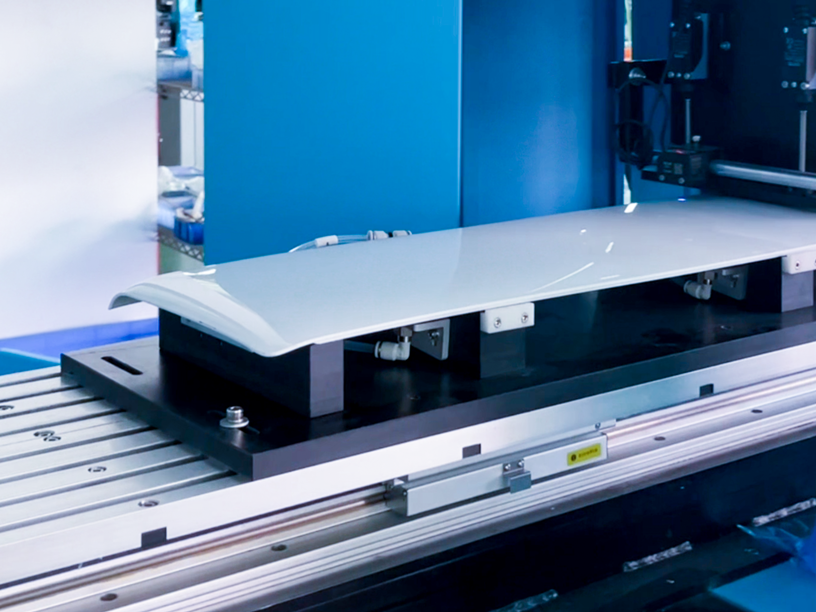
The assumptions a standard printer ships with
An off-the-shelf industrial printer is an exercise in averaging. The designers pick a printhead, a curing setup, a transport mechanism, and an I/O block that should satisfy the broadest plausible slice of buyers. That averaging works well enough for common jobs. It becomes a quiet tax on everything else.
The mismatch rarely announces itself in a dramatic failure. It shows up as a curing lamp sitting slightly too far from the print zone. A conveyor height that forces operators to shim the infeed. An ink system calibrated for a viscosity band that is a little off from what the plant’s coating line has already qualified. Each gap is survivable on its own. Together they turn every shift into a sequence of small compensations, and the machine never quite belongs to the process it is supposed to serve.
A customized printer starts from the job backward. The substrate, the part geometry, the line speed, and the existing automation stack are inputs, not afterthoughts. Flexibility, in this sense, is not a marketing adjective. It is the difference between a machine that the production floor adapts to and a machine that adapts to the production floor.
When the part decides the mechanics, not the catalog
Standard platforms are usually designed around flat rigid sheets or flexible webs within a defined thickness window. Real containers and components are messier than that. A cylindrical silicone part deforms under nip pressure, so pinch rollers are the wrong transport choice. A coated metal panel scratches if the feed table has high-friction contact points. A tapered bottle changes the print distance as it rotates, which means a fixed standoff will produce density variation across the seam.
The practical response is to engineer outward from the workpiece. Part handling, printhead standoff, curing angle, and even the choice of mandrel material get decided by what the line actually runs, not by what fits a generic platform. This is where customization earns its keep: not in exotic features, but in removing the friction that a standard architecture quietly imposes.
A medical tubing operation in Ireland offers a useful picture. A standard flatbed was pressed into service for silicone catheter sections, and the adaptation effort stretched across months without reaching a stable production state. The turning point came with a custom build using vacuum mandrel transport and a low-durometer contact surface. That line reached normal production within days of installation. The lesson is not that custom always wins. It is that some substrate-handling problems are architectural, and no amount of parameter tuning fixes an architecture that was never designed for the part.
The integration penalty nobody puts on the datasheet
A printer on a production line is a node in a control network, not a standalone appliance. Upstream fillers, downstream cartoners, inspection cameras, and the plant SCADA system all expect to exchange signals on a known protocol with a known fault hierarchy.
Standard printers typically arrive with a generic I/O block and a fixed menu of communication options. If the line controller speaks EtherCAT and the printer only offers discrete I/O, the gap gets bridged with signal converters, handshake workarounds, and fault codes that mean something different at every station. That integration work is real engineering labor, and it tends to reappear every time the line is reconfigured.
A customized build moves that work into the design phase. The fieldbus, the handshake sequence, and the alarm mapping are specified before the frame is welded. The difference shows up in startup time, but it also shows up months later when a new upstream device is added and the printer already speaks the language.
| Integration factor | Standard off-the-shelf printer | Customized printer |
|---|---|---|
| Protocol matching | Limited to built-in options, often discrete I/O only | Matched to plant standard, such as EtherCAT or Profinet |
| Integration engineering | Often dozens of hours of workaround logic | Reduced to configuration and verification |
| Signal conversion hardware | External gateways frequently required | Native protocol, no extra hardware |
| Fault diagnostics | Generic error codes | Mapped to line alarm hierarchy |
| Startup tuning after integration | Several days of adjustment | Usually measured in hours |
Throughput is a system property, not a printhead spec
Datasheet speed numbers assume a specific coverage, a specific resolution, and a specific curing profile. Change any of those and the real throughput moves. A standard machine with fixed lamp power and a fixed printhead arrangement has a narrow window where its rated speed and its actual speed are the same thing.
Customization widens that window by matching the print engine to the duty cycle the line actually runs. A job that is mostly small graphics with heavy white laydown needs a different curing strategy than a job that is mostly fine text at high resolution. A machine configured around one of those profiles will spend its life compromising on the other. The flexible answer is not a faster printhead. It is a print engine whose curing, ink delivery, and motion profile were sized around the real mix.
Industry commentary has been pointing at this shift for a while. Roland DG, announcing an expansion into industrial cylindrical and flatbed systems in 2026, framed the demand in terms of manufacturers “looking for ways to improve flexibility and responsiveness while maintaining quality and durability.” That is a fair summary of what buyers are actually asking for: not novelty, but a production tool that does not force a choice between change and stability.
Variable data and the economics of smaller, more frequent runs
The strongest case for customized printing shows up when the job mix itself changes. Product cycles are shorter, SKU counts are climbing, and regional or promotional variants arrive more often than the old plate-change economics can absorb. A standard analog or semi-analog workflow handles that by doing what it was built to do: amortize setup across volume. When volume per variant shrinks, the amortization stops working.
Digital customization changes the cost structure at the front end. There is no plate, no screen, and no fixed setup that has to be earned back. The first unit and the thousandth unit share the same file, and changing the file is the setup. This is why variable data, serialization, and per-unit codes move from being add-on capabilities to native workflow features. The machine does not care whether every unit is identical or every unit is different, and that indifference is the flexibility being sold.
The market data reflects the pull. Personalized digital packaging was estimated at roughly $3.4 billion in 2026, with forecasts pointing toward $8.9 billion by 2034 at a double-digit compound annual growth rate. Those figures cover more than industrial inkjet, but the direction is consistent: the economics of short, varied runs are improving, and tooling-heavy workflows are losing ground where variation is the norm.
Where customization stops being the right answer
Flexibility has a cost, and pretending otherwise makes the case weaker, not stronger. A customized platform typically carries a higher upfront price and a longer delivery cycle than a catalog machine. It also demands that the buyer know the process well enough to specify it. If the production mix is genuinely stable, one substrate, one geometry, one design running for years, a standard platform or a conventional analog process may deliver a lower total cost without any meaningful loss of capability.
Customization also does not repeal physics. Extreme geometries, unusual materials, and aggressive post-print processes can still fall outside what a direct-to-object inkjet system handles well, no matter how the fixture is designed. The honest position is that customization expands the envelope of jobs a digital printer can take on. It does not make the envelope infinite.
That is the right way to read the flexibility question. Not as a binary between standard and custom, but as a question of where the production mix sits and how often it moves. For operations where the mix shifts, where changeovers are frequent, and where the line is part of a larger automation ecosystem, a customized platform stops looking like a premium and starts looking like the configuration that matches reality.
NOVA builds its industrial inkjet platforms around that logic, with rotary, single-pass, and AI-assisted scanning architectures configured around the container or component rather than around a fixed catalog specification. The manufacturing and quality-control depth behind those builds matters as much as the print engine, because flexibility at the machine level only holds up when the fixture, the ink supply, and the spare parts pipeline are engineered with the same discipline.
Table of Contents
- The assumptions a standard printer ships with
- When the part decides the mechanics, not the catalog
- The integration penalty nobody puts on the datasheet
- Throughput is a system property, not a printhead spec
- Variable data and the economics of smaller, more frequent runs
- Where customization stops being the right answer