
 EN
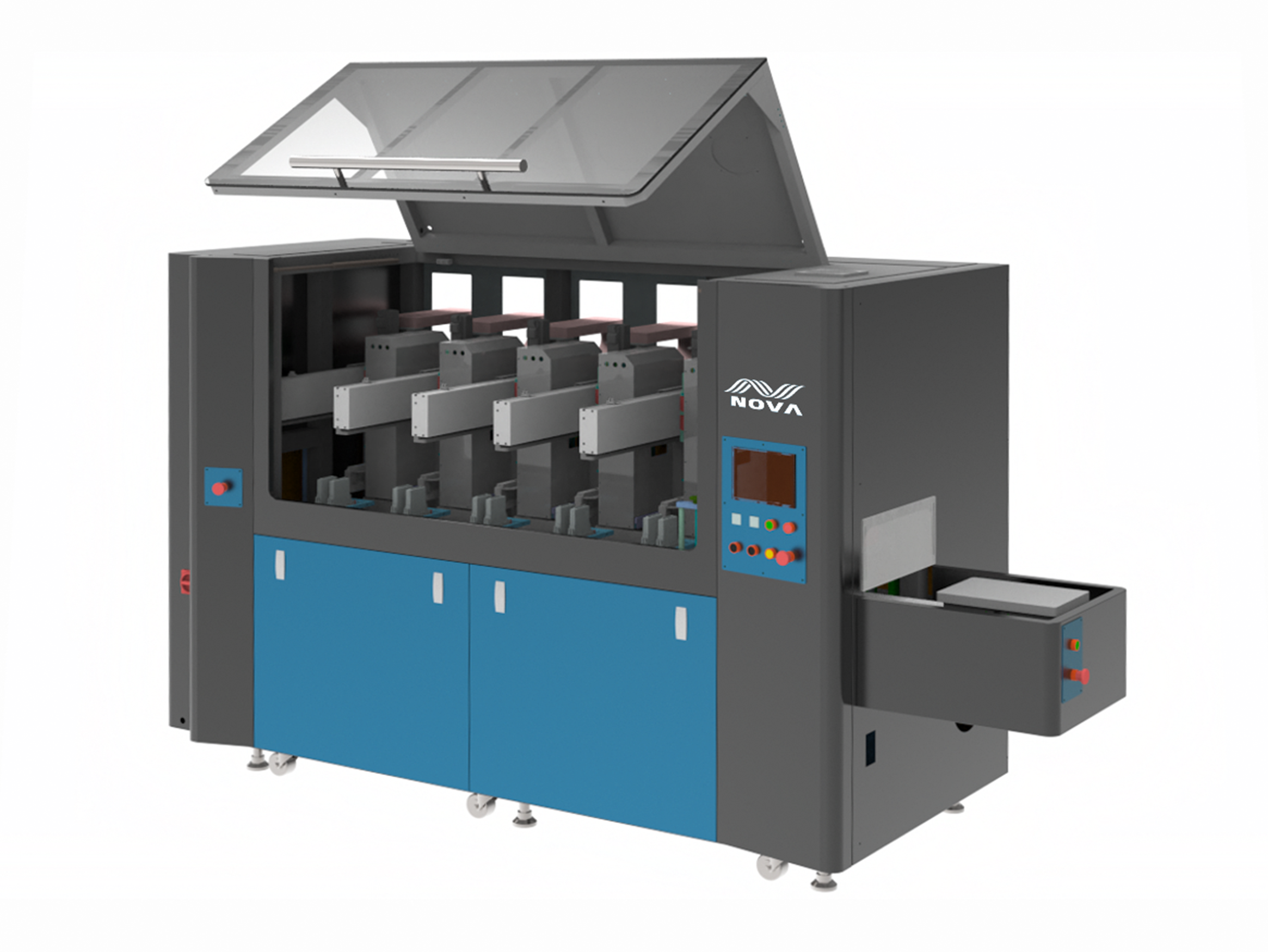
Walk onto any packaging line and the vocabulary gets loose fast. A operator might call a rotary drum printer "single-pass" because the part spins once under the head. A plant engineer might call a full-width array "rotary" because the belt keeps rolling. The labels blur, but the hardware does not. Rotary inkjet and single-pass inkjet solve different geometry problems with different mechanical bets, and mixing up the terms leads to buying the wrong box.
The clean way to separate them is to ask what moves and what stays still. In a single-pass architecture, the printhead array is stationary across the full width of the substrate, and the material moves underneath in one continuous motion. In a rotary inkjet setup, the printhead or the substrate rotates around an axis, and the image is built up over one or more revolutions while the head indexes laterally or the part turns in a fixture. That mechanical distinction drives everything downstream: throughput, resolution behavior, fault tolerance, and the kind of product that can be printed at all.
Rotary inkjet builds an image through controlled revolution, not repeated shuttling
The phrase "multi-pass" carries baggage from desktop printing, where a carriage sweeps back and forth and the page advances a fraction at a time. Rotary inkjet is not that. In a rotary imaging apparatus, a printhead travels around a curved print zone while the carrier advances along the axis of rotation. The head fires as it sweeps through the arc where it faces the media, and the combination of rotation and axial advance lays down the image grid.
The counterintuitive part, documented in rotary imaging patents, is that multi-pass printing around a rotating drum can be completed in the same amount of time as a conventional single-pass print. The reason is jetting frequency. When the rotation rate and axial advance are matched to the rated fluidic frequency of the nozzles, every nozzle stays busy through the whole revolution. Multiple nozzles can address the same print grid line across successive rotations, which improves uniformity without extending the cycle time. A 1200 × 1200 dpi page can be produced with two 312-nozzle arrays at 1/600-inch pitch running at 18 kHz, with an effective print time measured in seconds per page on a 20-inch circumference drum. That is not a slow process dressed up as a fast one. It is a different synchronization strategy.
The practical consequence is tolerance. Because several nozzles contribute to each grid line over a set of rotations, a single weak or dead nozzle does not automatically create a permanent white streak across the product. The redundancy is built into the motion profile, not added as a spare head.
Single-pass wins on raw linear throughput, then asks for tighter process control
A full-width array has one job: get the substrate from one end to the other as fast as the ink can cure. There is no carriage return, no index move, no second revolution. The head array spans the print width, and the substrate passes underneath once. For flat sheet, web, label stock, and corrugated board, that architecture is difficult to beat on linear speed. One industry comparison puts a similarly sized single-pass graphics system in the range of several thousand boards per hour, against a few hundred for a scanning alternative.
That speed comes with a known structural weakness. In a single-pass array, the failure of one nozzle produces an empty dot row or a missing halftone level at that exact lateral position, and the defect repeats for the entire run unless the system has redundancy or stitching logic to compensate. Neighboring printheads in the overlap zone can cover for each other through seamless stitching, but the engineering is non-trivial. The single-pass method is simply less forgiving than a multi-pass or rotary arrangement where multiple nozzles share the same image line.
Resolution behavior differs too. A 600 dpi single-pass UV head assembly is a common production benchmark, and compact head designs shorten the gap between droplet landing and UV pinning, which reduces dot spread and improves small-text legibility. Higher native resolutions exist, and grayscale single-pass systems can reach effective quality with 1200 dpi physical arrays and multiple drop sizes. But the quality ceiling is set by the fixed nozzle pitch across the width, not by a rotating sweep that can interleave drops over time.
The substrate shape decides the argument before the spec sheet does
A flat corrugated case, a pressure-sensitive label web, and a folding carton blank all live comfortably under a fixed full-width array. The material is planar, the transport is straightforward, and the single-pass advantage in linear speed is fully realized.
A cylindrical chemical pail, an aerosol can, a cosmetic tube, or a tapered bottle does not. Those surfaces present a curved print zone. A flat array can only reach a narrow tangent line, and rotating the part in front of a stationary head forces the print angle to change through the rotation. A rotary inkjet architecture is built for exactly that curved geometry. The printhead follows the arc, the part rotates in a fixture, and the image wraps around the circumference without needing a flat mandrel or a secondary label operation.
That is why rotary inkjet equipment commonly appears around variable data coding on cylindrical and curved packaging: date codes, lot numbers, QR codes, and short text blocks on bottles, tubes, and vials. The job does not demand a full-width graphics array. It demands a print path that can follow a curved surface at production speed and keep registration tight enough for a scannable code.
A real-world illustration shows why the two technologies often coexist rather than compete. During a lubricant blending plant's line upgrade, the flat carton coding station was running a full-width array at high linear speed, but the pail filling line kept stalling because the cylindrical pails had to be indexed to a separate station for date and batch codes. A rotary inkjet head integrated into the pail conveyor removed the secondary handling step. The single-pass array stayed on the carton line because its speed advantage was real there; the rotary unit took over the curved surface because the flat array simply could not follow the geometry. Neither machine replaced the other. The plant layout changed around the shape of the product.
A side-by-side that reflects production reality, not brochure numbers
| Dimension | Rotary inkjet | Single-pass inkjet |
|---|---|---|
| Primary motion | Head or part rotates around an axis; axial indexing builds the image | Fixed full-width array; substrate moves underneath once |
| Strongest substrate fit | Cylindrical, curved, tapered, and irregular 3D surfaces | Flat sheet, web, label stock, corrugated board |
| Throughput logic | High part rate through synchronized rotation; multi-revolution imaging can match single-pass cycle time | High linear speed; throughput scales with web width and transport speed |
| Nozzle fault behavior | Redundancy across revolutions softens a single-nozzle failure | A dead nozzle can create a repeating blank row without stitching redundancy |
| Resolution control | Interleaving across rotations; native grid set by nozzle pitch and rotation speed | Fixed widthwise nozzle pitch; quality set by head assembly and drop size |
| Capital and integration profile | Fixturing, rotation sync, and part handling dominate the engineering | Head array width, stitching, and substrate transport dominate the engineering |
| Typical production slot | Curved packaging, tubes, cans, pails, short and medium runs with variable data | Flat packaging, labels, graphics, long runs where linear speed pays back |
What the comparison table leaves out about maintenance and ink behavior
Two variables rarely make it into the selection spreadsheet, and both bite later.
The first is calibration drift on the rotary side. A rotating head or fixture introduces wear at the rotation interface, and the registration between successive revolutions depends on mechanical repeatability. The compensation is not glamorous: scheduled runout checks, encoder verification, and a disciplined fixture maintenance routine. A rotary system that is mechanically loose will show color-to-color misregistration on the wrap seam before it shows anything else.
The second is ink curing on the single-pass side. Because the array is fixed and the substrate moves fast, the window between droplet landing and pinning is short. Compact UV head assemblies and inline pinning LEDs narrow that window, but they also mean the curing module is not a peripheral. It is part of the print engine. A single-pass line with an undersized cure section will run at a fraction of its rated speed no matter what the head specification says.
A third factor is job mix. Rotary inkjet handles variable data well because the image is generated digitally on a rotating surface, but it is not the natural choice for a 2-meter-wide graphic panel. Single-pass handles wide flat work efficiently, but putting a curved part under a full-width array is a fixturing problem that rarely pays off. Honest evaluation means matching the substrate geometry first and the speed requirement second.
Where both architectures meet the same manufacturing standard
The choice between rotary and single-pass is not a loyalty test. It is a geometry and volume decision. A plant that runs both flat cartons and cylindrical pails will usually benefit from keeping both architectures in the building rather than forcing one to do the other's job badly.
That is the operating reality NOVA Inkjet Technology builds around. The company's equipment portfolio spans rotary screen and inkjet platforms alongside single-pass UV inkjet systems, which means the mechanical integration, head matching, and ink delivery choices are made from a production floor perspective rather than a single-technology catalog. For a converter or filler weighing the two approaches, the useful conversation is not which technology is newer. It is which motion profile fits the part, which fault mode the plant can tolerate, and which maintenance routine the team will actually follow. NOVA's engineering and supply chain setup supports that conversation at the machine configuration level, where the geometry decision gets settled.
Table of Contents
- Rotary inkjet builds an image through controlled revolution, not repeated shuttling
- Single-pass wins on raw linear throughput, then asks for tighter process control
- The substrate shape decides the argument before the spec sheet does
- A side-by-side that reflects production reality, not brochure numbers
- What the comparison table leaves out about maintenance and ink behavior
- Where both architectures meet the same manufacturing standard