 EN
A common reflex when shopping for an industrial inkjet system is to start with printhead specs and work outward. That order is backwards. The part decides everything. A 180 mm diameter cosmetic tube, a 60 mm tall aerosol cap, and a flat corrugated blank each demand a different relationship between the print engine and the material. No amount of head resolution compensates for a fixture that cannot hold the part at the right distance from the nozzles.
Customization options on an industrial inkjet printer are really a series of mechanical and process decisions stacked in a specific order. The printhead and ink chemistry sit near the top of that stack, supported by transport, tooling, pre-treatment, and curing choices underneath. Skip a layer and the system may run, but the adhesion or registration will be inconsistent in ways that show up mid-shift rather than at commissioning.
Motion and tooling come before print quality
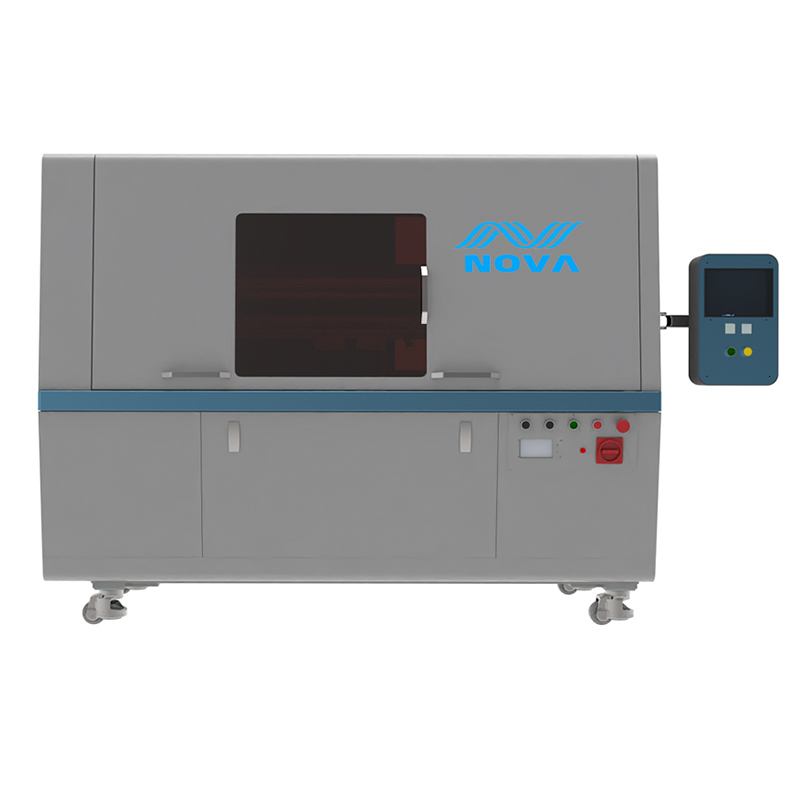
The most consequential customization is often invisible in the spec sheet: how the part is presented to the head. A servo-driven rotary table with an adjustable angled fixture is not an accessory. It is the mechanical foundation that makes curved and tapered printing repeatable. NOVA's ECO Plus-5 platform, for example, uses a magnetic levitation linear motor alongside a servo-driven rotation system, and the fixture angle can be adjusted to keep the print zone normal to the head across a tapered surface.
Universal loading and unloading robots, pre-registration with a bottom camera or a linear body camera, and the choice between running parts standing upright or lying down all fall into this same layer. These choices determine cycle time and labor content before ink ever touches the substrate. A line that requires an operator to hand-load each part into a fixture will not suddenly become a high-throughput line because the head array was upgraded.
Pre-treatment and curing are process decisions, not add-ons
Surface energy is where a lot of industrial inkjet projects quietly fail. Polypropylene and some coated metals resist aqueous and UV inks unless the surface is activated first. That is why flame, plasma, and corona pre-treatment devices appear as configurable options on production platforms rather than as standalone gadgets. The right choice depends on the substrate family and the line speed. Corona treatment is common on web and film; flame treatment suits certain three-dimensional polyolefin parts; plasma sits in between and can be tuned more precisely.
Curing follows the same logic. UV LED pinning, where the ink is partially frozen immediately after landing to lock dot placement, and full cure later in the process, are separate stages with separate hardware requirements. A system configured with pinning but an undersized final cure section will run below its rated speed. The customization question is not whether to include UV LED curing, but how the pinning and final cure zones are sized against the ink laydown and the line speed.
Printhead and ink choices are locked to the application, not to a catalog
The printhead is the most visible customization point, and also the one most often constrained by supply reality. Industrial piezo heads come from a small number of manufacturers, and each family has its own fluid compatibility, native resolution, and grayscale behavior. Ricoh Gen6 heads, for instance, appear across NOVA's cylinder and flatbed platforms, while the CF3R recirculating head is used where ink settling or pigment stratification is a concern. A recirculating ink path keeps fluid moving when the head is idle, which matters for pigmented white and metallic inks that would otherwise separate in the nozzle chamber.
Ink selection sits on top of that. UV-curable, aqueous, and solvent formulations each demand different wetted materials, different maintenance routines, and different substrate preparation. A system configured for one chemistry cannot simply be switched to another by swapping a cartridge. The fluid path, the head, and the curing module form a matched set.
A side-by-side of standard configuration and application-driven customization
| System layer | Standard configuration | Customization latitude | Consequence of getting it wrong |
|---|---|---|---|
| Part presentation | Flat platen or fixed fixture | Servo rotary table, adjustable tilt fixture, bottom camera pre-registration | Misregistration and part jams on curved or tapered work |
| Pre-treatment | None | Flame, plasma, or corona integrated inline | Poor adhesion, rub-off, or inconsistent wetting |
| Curing architecture | Single UV LED cure zone | Separate pinning and final cure zones, sized to line speed | Dot spread, color shift, or speed capped by cure |
| Printhead | Fixed head family and count | Head selection matched to fluid and resolution target | Nozzle clogging or resolution shortfall |
| Ink chemistry | One qualified ink set | Recirculating path for settling inks, application-specific formulation | Pigment separation, poor print resistance |
| Inspection | None or basic | Integrated camera inspection system | Defects caught downstream instead of at the head |
A real-world constraint that reshaped the fixture, not the printhead
During a packaging line upgrade for a personal care product manufacturer, the target was a tapered tube with a diameter that narrowed toward the cap. The initial approach used a fixed vertical fixture, and the print quality degraded toward the narrow end because the standoff distance changed across the print zone. The fix was not a higher-resolution head. It was an adjustable angled tooling fixture that tilted the tube so the surface stayed parallel to the head through the print pass. Registration recovered, and the inspection camera rejection rate dropped accordingly. The printhead never changed. The mechanical presentation did.
That pattern repeats across industrial inkjet projects. The print engine is usually the most mature part of the system. The variables that determine whether the installation works in production are the fixture, the pre-treatment, and the cure window.
What customization does not fix, and the one-stop path around it
Honest limits exist. Customization cannot make a flat full-width array print around a cylinder. It cannot turn a solvent-optimized fluid path into an aqueous one without a hardware change. It cannot make a slow-curing ink compatible with a line speed that leaves no dwell time. Those are architecture decisions, not configuration options.
What a disciplined customization process can do is shorten the distance between the application description and a machine that actually holds tolerance on the floor. NOVA structures that process as a sequence: initial consultation, custom design, simulation and sample testing, then manufacturing and quality control before delivery and training. The sample testing stage is where fixture geometry and pre-treatment choices get validated against the real substrate, rather than against a specification sheet. NOVA's manufacturing and supply chain setup supports that sequence at the machine level, which is where most of the risk in an industrial inkjet installation actually sits.
Table of Contents
- Motion and tooling come before print quality
- Pre-treatment and curing are process decisions, not add-ons
- Printhead and ink choices are locked to the application, not to a catalog
- A side-by-side of standard configuration and application-driven customization
- A real-world constraint that reshaped the fixture, not the printhead
- What customization does not fix, and the one-stop path around it