 EN
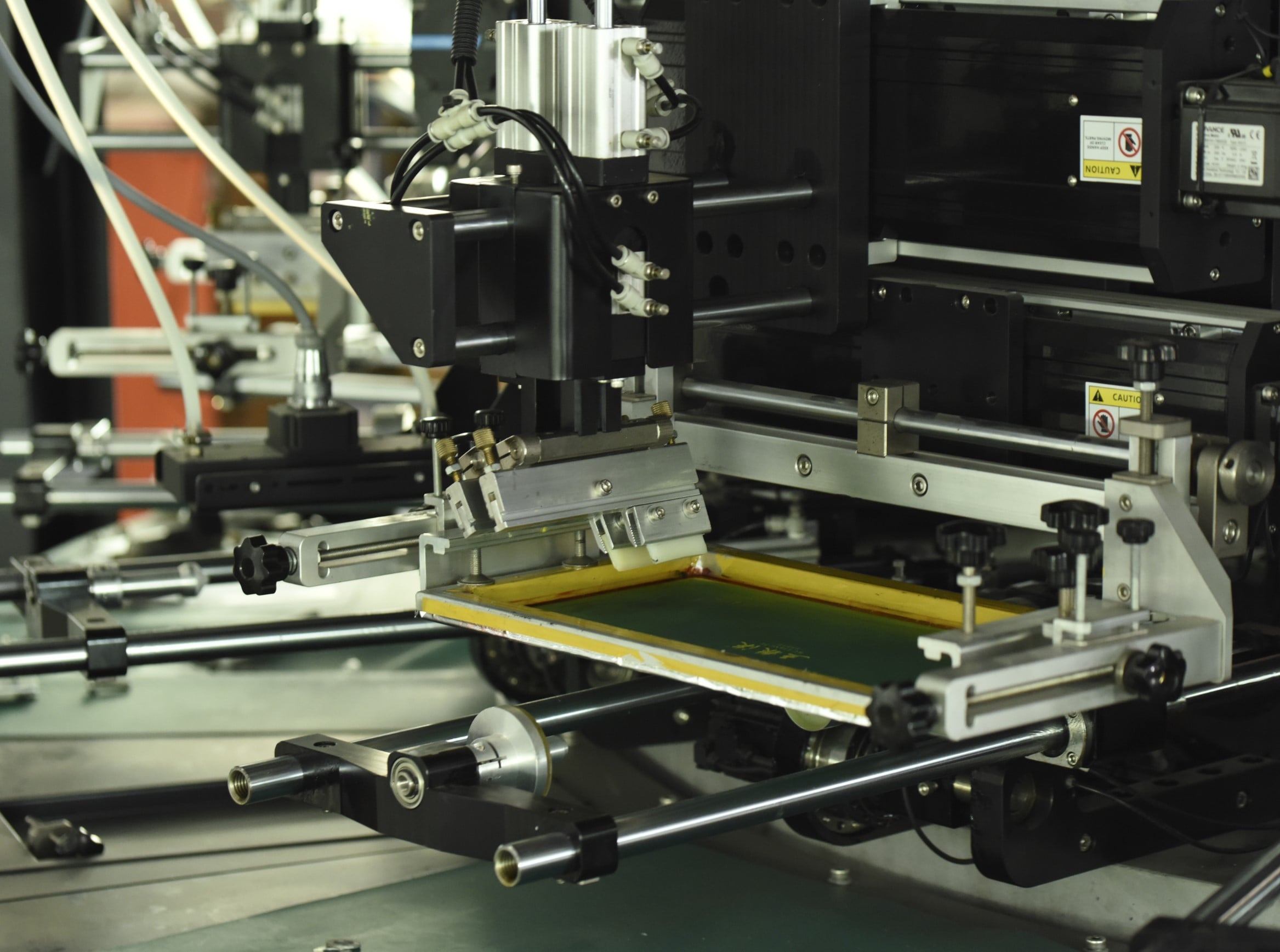
Walk through any industrial print floor and the assumption is that digital took over. Inkjet and laser systems get the press releases, the trade show floor space, and the venture money. Yet the flatbed screen printer sitting in the corner, the one with the wooden squeegee handle and the mesh stretched over an aluminum frame, is still running production shifts in packaging shops, membrane switch lines, and automotive glass plants. That persistence is not nostalgia. It is a set of physical capabilities that digital inkjet has not displaced, and in some growing segments, cannot match without paying a penalty in cost, speed, or material compatibility.
Smithers’ research on screen versus digital printing puts the relationship in plain numbers. Screen and digital printing together were forecast to represent $81.7 billion in global value in 2025, about 58.8 percent of the total industrial print market. Screen printing specifically was valued at $63.8 billion in industrial and functional applications, and that segment is projected to grow at a 4.4 percent compound annual rate through 2030, reaching $79.3 billion. The graphics and packaging work that people associate with screen’s decline is not where the money is moving. The growth is in textiles, automotive components, and printed electronics, where the process does something digital still struggles to do economically.
The physics of a thick wet layer
The defining mechanical difference is ink volume. A screen printer pushes a high-viscosity fluid through a patterned mesh, and the deposit that lands on the substrate can run from roughly twenty to a hundred microns in a single stroke. Inkjet heads, by contrast, are built around low-viscosity fluids, often in the two to twenty centipoise range, and a single pass typically lays down a film measured in a few microns or less. That difference is not a rounding error. It changes what the printed layer can do.
A thick screen-printed deposit carries more pigment per unit area, which translates directly into opacity, color intensity, and durability. White ink on a dark substrate is the classic example. A screen print of white can achieve hiding power in one pass that an inkjet system may need multiple passes or a separate primer to approach. The same logic applies to protective coatings, adhesives, and conductive pastes. When the functional requirement is a layer that must conduct electricity, resist abrasion, or survive years of UV exposure, the ability to deposit material in a substantial film is a structural advantage, not a legacy quirk.
Where digital’s ink window closes and screen stays open
The ink compatibility gap is the quieter reason screen printing holds its ground in industrial settings. Inkjet printheads are precision fluidic devices with nozzle diameters measured in microns. They require fluids filtered to very fine tolerances and formulated within a narrow viscosity window. Highly pigmented pastes, heavy metallic inks, and specialty adhesives that are routine in screen printing often cannot pass through an inkjet head at all, and when a jettable version is formulated, it tends to be expensive and slow to lay down the required film thickness.
Screen printing does not face that constraint in the same way. A mesh can pass a fluid loaded with particles or pigments as long as the largest particle is compatible with the mesh opening, and the process runs with inks whose viscosity can sit in the thousands of centipoise. That is why conductive silver pastes, dielectric layers, carbon traces, and pressure-sensitive adhesives for membrane switches are still commonly applied by screen. The printable materials ecosystem for screen is broader and cheaper per liter than the qualified ink set for a given inkjet platform.
| Process characteristic | Screen printing | Digital inkjet |
|---|---|---|
| Typical single-pass deposit | 20–100 μm | 1–5 μm |
| Ink viscosity window | Up to thousands of cP | Roughly 2–20 cP |
| Resolution floor | ~50–150 μm with standard mesh | 15–50 μm typical |
| Setup per job | Screen making, 10–20 minutes | Digital file, near zero |
| Best economic zone | Repeat runs, thick films, specialty fluids | Short runs, variable data, fine detail |
The resolution row is where screen gives ground. Standard mesh counts limit fine feature definition to roughly fifty to one hundred fifty microns, and pushing to higher mesh counts for finer lines reduces the ink volume that passes through, which compromises the very thickness advantage that makes screen useful. Screen printing does not win on fine detail. It wins on material delivery, and the applications that value material delivery over line width are the ones where the process remains the default.
Printed electronics is not a niche, it is a growth path
The segment where screen’s thick-film capability matters most is printed and flexible electronics. Membrane switches, the layered constructions behind keypads, appliance control panels, and automotive dash interfaces, depend on screen-printed conductive tracks and graphic layers. A front film with polydome membrane switches can be produced by applying the functional layers through screen printing rather than assembling multiple films, which reduces material count and cost. Automotive glass printing follows a related logic: defroster lines, antenna patterns, and obscuration bands are screen-printed because the conductive and opaque layers need a film weight that inkjet does not deliver economically at production speed.
Screen printing is also the workhorse for stretchable and flexible electronics research and production. Conductive pastes based on silver nanowires, carbon nanotubes, and graphene are routinely transferred onto elastomers through patterned mesh, and the process is valued for its simplicity, low cost, and ability to handle large-area fabrication. A thicker deposited layer tolerates a degree of deformation better than a very thin printed feature, which matters when the end product bends or stretches. Those are not laboratory curiosities. They are the manufacturing steps behind wearable sensors, heated textiles, and in-mold electronic structures.
The honest case for hybrid lines instead of a winner-take-all argument
The practical answer in most shops is not screen or digital. It is both, sequenced by job economics. A hybrid workflow assigns high-color-count, variable, short-run work to digital and routes lower-color-count, larger-repeat work to screen automatics. Screen lays down the primer, the white base, or the specialty effect, and digital adds the variable data or the fine graphic detail on top. That combination lets a shop use screen’s cost advantage on the layers where thickness and material compatibility matter and digital’s flexibility on the layers where personalization and detail matter.
The drawbacks of hybrid are real and worth stating. Running two machines instead of one increases the floor space, the labor, and the energy footprint per finished job, and the environmental profile is typically worse than a pure digital line for the same output. Screen also carries setup cost per job, roughly ten to twenty minutes to make and mount a screen even with direct-to-screen imaging, which makes small runs uneconomical. Screen printing is not the right choice for a hundred-piece run with a different design each time. It is the right choice when the run length amortizes the screen and the deposit thickness earns its place in the product’s function.
A membrane switch line where the ink choice decided the process
A control panel manufacturer supplying appliance OEMs ran into a recurring problem with a digital UV inkjet system on a short-run membrane switch product. The conductive traces printed fine, but the adhesive layer that bonded the top graphic film to the circuit layer did not hold under elevated temperature and humidity testing. The jettable adhesive qualified for the printhead was a compromise formulation, and reformulating it to meet the bond strength requirement pushed the viscosity outside the head’s stable jetting window.
The production answer was not a better inkjet head. It was a screen station inserted before the digital unit. The adhesive was screen-printed with a heavy, high-solids fluid that the mesh handled without difficulty, while the variable graphic and the fine test marks stayed on the digital unit downstream. The line kept the digital flexibility for the part-specific data and recovered the bond strength that the application required. That is the pattern in industrial print: the process is chosen per layer, not per machine, and screen stays in the line wherever the fluid or the film weight demands it.
For operations weighing where screen fits alongside digital, the configuration work benefits from a platform perspective rather than a single-technology pitch. NOVA Inkjet Technology builds customized industrial inkjet systems and works with production teams on print configuration testing, substrate-specific engineering, and integration with existing screen or hybrid workflows, so the process mix is matched to the product rather than forced onto one printing method.