 EN
EN
The Challenge of Printing on Cylindrical Surfaces
Why Traditional Flatbed Printers Fail on Curved Surfaces
Regular flatbed printers work best on flat materials but run into problems when printing on round objects. The printheads stay in one place, so they just can't handle curved surfaces properly. What happens is the ink either collects in certain spots where the printer touches the object or doesn't stick evenly as things spin around. This leads to all sorts of alignment problems and generally bad looking prints. According to some industry data from last year, nearly a third of all cylinder shaped products needed to be printed again because of these kinds of issues. Things get even trickier when dealing with different sizes since those fixed printheads can't adjust their distance from whatever surface they're printing on. The folks who wrote the report on printing challenges mentioned something interesting here too - manufacturers working with things like tapered drinking glasses or rough surfaced metal pipes really feel the limitations of standard printing equipment.
Common Defects in Cylindrical Product Printing
- Seam banding: Visible overlaps where the print starts and ends
- Radial distortion: Graphics stretch near the poles of curved objects
- Incomplete curing: UV light shadows on concave areas prevent full ink curing
Industries Most Affected by Cylindrical Printing Limitations
Beverage manufacturers lose an estimated $2.7M annually from smudged aluminum can logos, while cosmetic brands see 18% higher return rates due to label defects on cylindrical packaging. Medical device producers using traditional methods face 40% longer production cycles to accommodate extensive post-print inspections.
How the Cylindrical UV Inkjet Printer Transforms Production
Core Technology Behind Cylindrical UV Inkjet Printer Precision
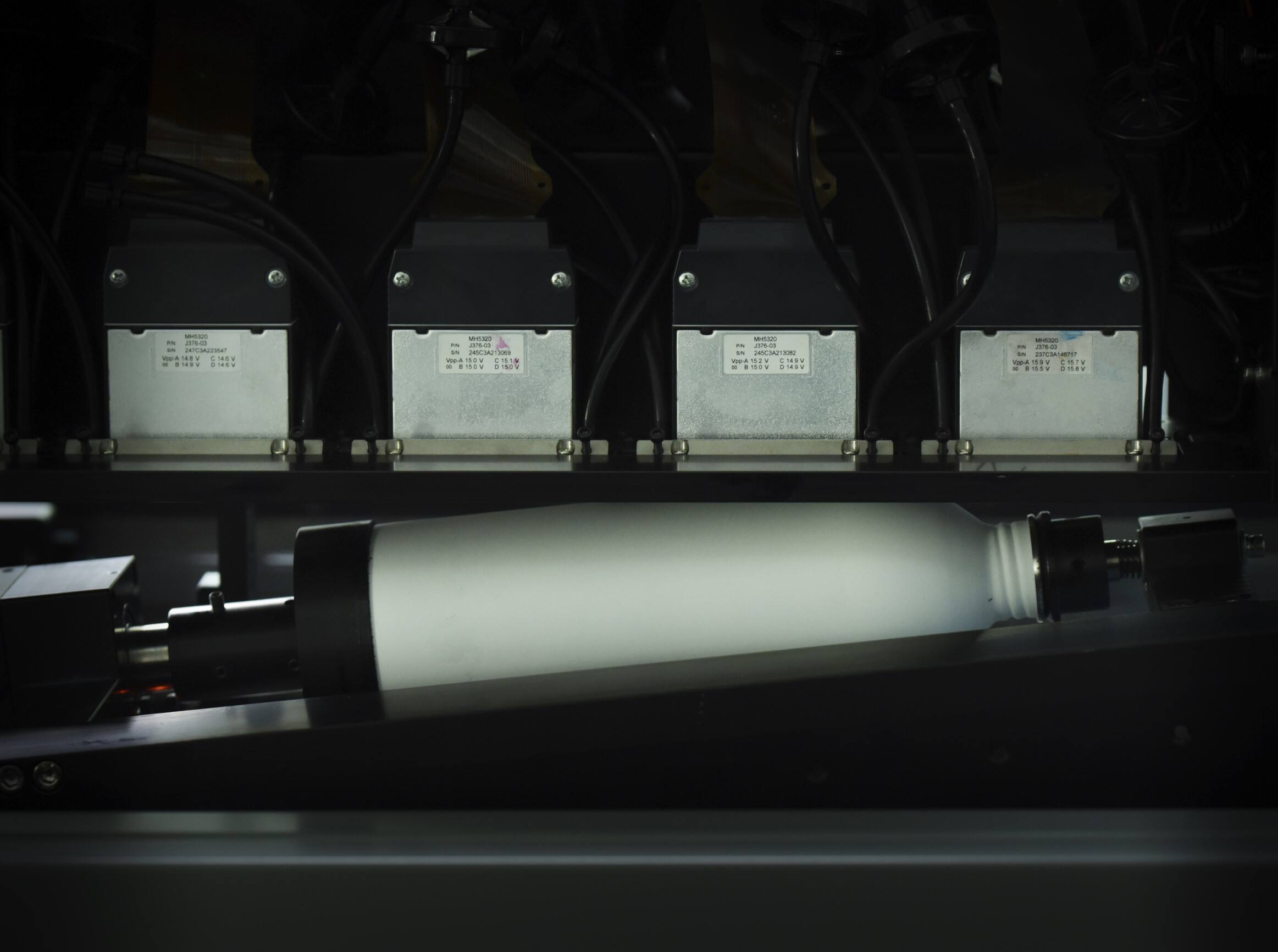
Cylindrical UV inkjet printers get around the problems of flatbed models thanks to their rotating mechanisms working in sync with advanced inkjet technology. These machines keep printheads and substrate movement perfectly matched within about 0.1mm accuracy, which means text and images land exactly where they should every time. The high res piezo printheads spray out those special UV inks at around 1,200 dots per inch, so we're getting really crisp prints even when stuff spins pretty fast during production runs for cups, bottles or parts used in manufacturing. What makes these systems stand out is how automation takes care of all that tricky positioning work normally done by hand, cutting down on those annoying registration issues that plague traditional printing methods.
Real-Time Rotation Synchronization for Seamless Prints
The motion control system can adjust when ink gets deposited depending on how fast things spin around (up to 300 RPM) and the size of whatever surface needs printing. The software adapts as it goes along, so if something starts getting narrower or has odd shapes during printing, it still manages to switch smoothly between different kinds of containers. A recent study by the Print Quality Consortium back in 2023 found that these closed loop servo feedback systems hit about 98.6% accuracy for positioning across all sorts of sizes ranging from 30mm right up to 90mm. That basically stops those annoying color bands and overlapping patterns that often plague bottle labels and other promotional items.
UV Curing Advantages for Cylindrical Substrates
When using UV curing, the ink actually sets within half a second or so, which stops any distortion caused by things like centrifugal forces or surface tension issues during printing. What we get are prints that have what's called 4H pencil hardness, making them about 20 percent more resistant to scratches compared to those old solvent based options out there. Plus, they need only around 35% of the energy required for traditional thermal drying methods. Tests done by third parties show these UV cured inks still stick pretty well too, maintaining roughly 95% adhesion strength even after going through more than 500 dishwasher cycles on materials such as glass, metal, and plastic surfaces. Because of this kind of toughness, manufacturers find it works really well for stuff like those heavy duty brewery growlers people keep refilling, along with all sorts of pharmaceutical vials that just cant afford to lose their labels no matter how much they get handled day after day.
Data: 95% Reduction in Misalignment Errors With Cylindrical UV Inkjet Printer
Looking at production data from twelve different bottling plants reveals something pretty impressive: waste caused by misalignment issues has dropped by almost 95% after switching to cylindrical UV systems. When comparing old pad printing methods which had error rates around 18%, the new UV inkjet technology brings those numbers down to just 0.9%. Why? Because these systems come equipped with real time optical inspection that catches and fixes positional problems as they happen. Mid sized operations are seeing serious benefits too. According to the PQC Efficiency Report from last year, companies save approximately seven hundred forty thousand dollars each year with this upgrade. These savings not only speed up return on investment but also help meet those tough quality requirements set forth for food products and cosmetic packaging industries where precision matters most.
Key Engineering Principles Behind Reliable Cylindrical Printing
Rotary Axis Control and Substrate Detection Systems
Sub-micron accuracy (under 10µm) is achieved through precise rotary axis synchronization. Servo motors regulate rotation to match printhead movement, while sensor arrays detect diameter variations as small as ±0.1mm in real time. This level of control prevents seam banding and ensures consistent registration, especially on tapered or non-uniform containers.
Adaptive Printhead Positioning for Variable Diameters
The nozzles and ink angles automatically adjust as needed to keep the print quality consistent on all sorts of materials, whether it's something as thin as a 5mm plastic tube or as thick as a 300mm metal container. The system uses smart control software that constantly updates where the printer heads move, doing these calculations at an impressive rate of 1,000 times per second. This has cut down on those annoying blurry edges we used to see with older printing methods by almost 90%. What makes this really useful is how it works across different products too. Printers can switch from delicate glass perfume bottles straight to tough aluminum drink cans without needing anyone to fiddle with the settings or replace parts. Just plug in the new item and go.
Material Compatibility: Glass, Metal, Plastic, and More
These UV curable inks form chemical bonds with all sorts of materials thanks to specific LED wavelengths. For glass surfaces we typically use 385nm LEDs without needing any primer at all. When it comes to metal surfaces, special nano coatings help create that extra layer of protection against scratches. Labs have tested this stuff on over twenty different materials and found that about 98 percent of the ink stays put even after going through extreme temperature changes from minus forty degrees Celsius right up to 120 degrees. That kind of performance makes these inks ideal for products that need to survive whatever conditions they might face between freezer storage and oven baking.
Real-World Impact: Boosting Efficiency in Beverage Container Manufacturing
Before: Inconsistent Labeling and High Waste Rates
Traditional pad and screen printing caused 12−18% waste in beverage container decoration due to misaligned labels and inconsistent colors (2023 Packaging Industry Report). Poor adhesion led to smudging, incomplete patterns, and uneven gradients—rendering one in eight containers unsellable.
After: Full-Color Branding with Cylindrical UV Inkjet Printer
The latest generation of cylindrical UV inkjet printers can rotate fully around products, which means companies can print sharp logos and realistic images all around aluminum cans, glass bottles, and those plastic PET containers too. The magic happens because these printers cure ink instantly under UV light. This means factories get about 98 percent good prints right off the line without waiting for anything to dry first. A big name in the drinks industry cut their setup time down nearly two thirds just by switching to this tech. Plus they started creating those amazing holographic effects that traditional printing just couldn't handle.
ROI Analysis: Payback Period Under 14 Months
Cylindrical UV inkjet adoption reduces per-unit decorating costs by 40−60% through lower ink waste and labor. A bottling plant recovered its $220k investment in 11 months by cutting material waste from 15% to 2% and doubling hourly output. With automated print calibration ensuring round-the-clock consistency, manufacturers sustain profitability despite fluctuating order volumes.
Future Trends and Strategic Adoption of Cylindrical UV Inkjet Printers
AI and Automation: Smart Calibration Reducing Setup Time by Up to 50%
Modern AI systems can adjust themselves on the fly for different sizes and shapes. The machine vision tech looks at each object as it goes through the process, then tweaks things like where the printhead sits, how big those ink drops are, and gets everything spinning just right. No more messing around with trial and error setups manually, which saves roughly half the prep work that used to take so long. Factories have seen something like a 90% drop in mistakes made by people when dealing with tricky shapes such as bottle tapers according to Packaging Digest from last year.
Predictive Maintenance Alerts Enhancing Uptime
Integrated IoT sensors monitor UV lamps, ink pumps, and rotary bearings, forecasting failures before they occur. An automotive parts manufacturer achieved 98.6% uptime using vibration analysis that detects bearing wear over 72 hours in advance. Cloud-based dashboards provide maintenance teams with prioritized alerts, reducing unplanned downtime by 67%.
IoT-Connected Printer Networks Shaping the Future of Production
Leading factories integrate cylindrical UV inkjet printers into unified digital ecosystems. Networked systems share job parameters, ink usage, and quality data across production lines. One beverage can producer reduced ink waste by 31% through centralized color management and achieved real-time tracking of over 500,000 units daily.
Choosing the Right Cylindrical UV Inkjet Printer: Volume, Materials, and Vendor Support
When selecting a system, consider:
- Throughput Needs: Machines exceeding 1,000 units/hour require industrial-grade curing
- Substrate Versatility: Confirm compatibility with plastics, glass, and metals up to 300mm diameter
- Technical Support: Choose vendors offering sub-24-hour response and certified training
Cost vs. Long-Term Quality Gains: Evaluating the True ROI
Although cylindrical UV inkjet printers have a 15−20% higher initial cost than flatbed models, their precision generates significant savings. A cosmetics brand eliminated $220k/year in misprinted tube waste through pixel-perfect alignment, achieving full ROI in 13.2 months. Energy-efficient UV-LED curing further cuts operating costs by 18−22% compared to mercury lamp systems.
Frequently Asked Questions (FAQs)
What are the common problems with traditional flatbed printers when used on cylindrical surfaces?
Flatbed printers have difficulty with curved surfaces because the printheads are stationary, leading to misalignment and uneven ink distribution.
How do cylindrical UV inkjet printers overcome traditional printing challenges?
They employ synchronized rotation technologies and advanced UV curing to ensure precise and durable prints on cylindrical surfaces.
What industries benefit most from cylindrical UV inkjet printers?
Beverage, cosmetics, and medical device industries benefit from the precision and efficiency these printers provide.
How do these printers improve production efficiency?
They significantly reduce waste, minimize errors with real-time optical inspection, and enhance throughput with automated systems.
What materials are compatible with UV curable inks used in these printers?
They bond well with materials like glass, metal, and plastic due to specific LED wavelengths and nano coatings.
Table of Contents
- The Challenge of Printing on Cylindrical Surfaces
- How the Cylindrical UV Inkjet Printer Transforms Production
- Key Engineering Principles Behind Reliable Cylindrical Printing
- Real-World Impact: Boosting Efficiency in Beverage Container Manufacturing
-
Future Trends and Strategic Adoption of Cylindrical UV Inkjet Printers
- AI and Automation: Smart Calibration Reducing Setup Time by Up to 50%
- Predictive Maintenance Alerts Enhancing Uptime
- IoT-Connected Printer Networks Shaping the Future of Production
- Choosing the Right Cylindrical UV Inkjet Printer: Volume, Materials, and Vendor Support
- Cost vs. Long-Term Quality Gains: Evaluating the True ROI
- Frequently Asked Questions (FAQs)